Layered Defence: Unpacking India's Air-Defence Strategy Against a Gulf-Scale Threat
The concept of layered defence is not new to the world of air defence. It's a strategy that has been employed by various countries to effectively counter aerial threats. However, the magnitude of the threat and the scale of the attack can vary greatly, and it's essential to understand the nuances of each scenario.
In the context of India's air-defence strategy, the country has been working towards developing a robust and effective defence system. The experience gained during Operation Sindoor has been instrumental in shaping this strategy. The operation demonstrated the value of a layered defence architecture, where expensive interceptors like the S-400 and Project Kusha are reserved for the most threatening targets, while cheaper systems like MRSAM, Akash, and guns deal with drones and lower-end targets.
But how many interceptors would India need to defend against a Gulf-scale threat? To answer this question, we need to consider the numbers. The Gulf region witnessed a massive missile and drone barrage, with over 3,700 aerial threats. Breaking down these threats, we have at least 623 ballistic missiles, 35 cruise missiles, and the remainder being drones or other aerial threats.
Assuming a 90% effective interception rate, the defensive system would need to defeat roughly 561 successful engagements against the ballistic missiles. Allowing for approximately 10% additional interceptor expenditure because of failures, retargeting, or multiple-shot engagements, the requirement could rise to 623–690 interceptor launches. This is where S-400 and future Project Kusha become important. They should not be expected to engage every drone or cruise missile. Their scarce long-range interceptors should be concentrated against ballistic missiles, high-value aircraft, and the most dangerous stand-off weapons.
The reported 35 cruise missiles would generate a much smaller numerical requirement, but cruise missiles are more difficult because of their low-altitude flight profiles and potentially complex terrain masking. At a 90% interception requirement, the requirement could be put at roughly 40–60 medium/long-range SAM interceptors, assuming other layers provide additional opportunities.
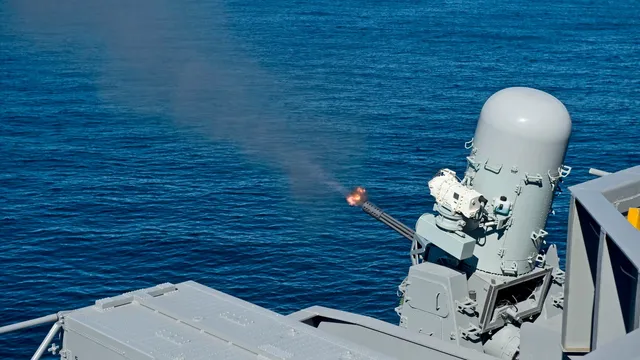
The Gulf experience becomes especially important when considering the use of S-400-class missiles against drones. Using S-400-class missiles against thousands of drones would be economically unsustainable. The 2,256 UAE drones alone would require over 2,000 engagements, even with a single interceptor per drone. This is precisely why the lowest layer needs guns, electronic warfare, dedicated counter-UAS interceptors, and very inexpensive missiles, rather than consuming S-400 or Kusha weapons.
India's Operation Sindoor experience reinforces this principle. Official Indian accounts specifically highlighted the use of counter-UAS systems, shoulder-fired weapons, legacy air-defence systems, modern SAMs, and guns as different layers. Analysis of the operation also noted that relatively inexpensive guns were useful against smaller drones.
If India had to defend against a barrage of approximately 3,700 aerial threats of the type in this scenario, the inventory would need to be conceptualised like this:
- 623–690 interceptors for ballistic missiles
- 40–60 medium/long-range SAM interceptors for cruise missiles
- Thousands of guns, electronic warfare systems, dedicated counter-UAS interceptors, and very inexpensive missiles for drones
These numbers are not procurement requirements. They are a stress-test illustrating the magnitude of stocks required if India were exposed to a barrage comparable to the one in this scenario.
There is an important additional point: the same target can be engaged by several layers, so the inventory cannot be calculated simply by adding the numbers. A ballistic missile might first be engaged by a Kusha/S-400 interceptor, then by another layer if the first engagement fails. A cruise missile could pass from long-range surveillance to MRSAM and then Akash or a close-in system.
That is exactly why the command-and-control architecture is as important as the missile inventory. India's IACCS and Army's Akashteer are designed to create a common air picture and coordinate sensors and shooters. During Operation Sindoor, official Indian accounts specifically credited integrated command-and-control and multilayered defence with neutralising Pakistani attacks.
The Gulf numbers demonstrate why India should avoid building an air-defence architecture dominated by expensive long-range missiles. If India faced 3,700+ aerial threats, even a 90% interception rate would leave approximately 370 threats getting through mathematically. At a 70% effective rate, that rises to roughly 1,114.
Therefore, the objective should not simply be '90% kill probability.' It should be 90%+ system effectiveness through multiple opportunities to defeat each important target. For India, that means S-400 + Project Kusha + MRSAM + Akash/Akash-NG + QRSAM + dedicated C-UAS + guns + EW, all connected through IACCS/Akashteer.
The most expensive interceptor should kill the most dangerous target. A ₹crore-class missile should not be used to destroy a ₹lakh-class drone when a gun, EW system, or inexpensive interceptor can do the job. By adopting a layered defence strategy, India can ensure that its air-defence system is robust, effective, and economically sustainable, even in the face of a massive Gulf-scale threat.
Based on reporting from the original source. See our Copyright Policy for details.