India's MALE UAV Conundrum: Balancing Sovereignty and Technological Advancements
India Defence & Aerospace Indigenisation Summit 2026
Accelerating private defense manufacturing, UAV innovation, and strategic aerospace corridors.
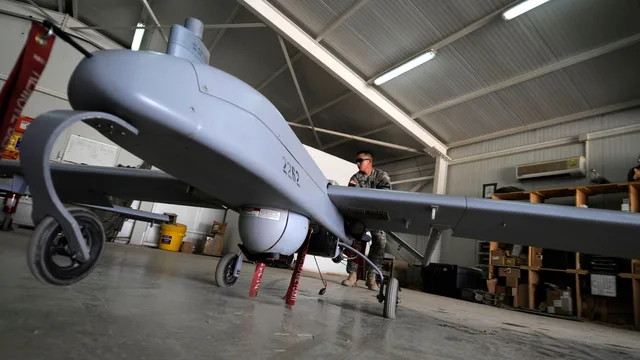
Explore Strategic Intel →India's growing unmanned aerial vehicle ecosystem has sparked an intriguing debate: how does Drishti-10 stack up against the indigenous DRDO TAPAS in the MALE UAV stakes? Both belong to the Medium Altitude Long Endurance category, designed for persistent intelligence, surveillance, and reconnaissance. While Drishti-10 boasts industry-developed advantages, its capabilities seem broadly comparable to those of TAPAS.
The comparison is particularly interesting because TAPAS represents years of investment by DRDO and Indian industry in developing a sovereign MALE UAV ecosystem. The platform has been designed around long-endurance surveillance missions and incorporates an indigenous avionics and sensor architecture. One of the most important capabilities is satellite communication. TAPAS incorporates an integrated Ku-band SATCOM system intended to enable beyond-line-of-sight operations at ranges exceeding 1,000 km. This gives the aircraft the ability to operate well beyond the direct communications range of its ground-control station.
Drishti-10 similarly incorporates SATCOM-based beyond-line-of-sight connectivity. However, the practical significance of those differences needs to be assessed through independent operational testing rather than marketing specifications. Flight performance is another area where the comparison becomes interesting. Publicly discussed figures for Drishti-10 have included approximately 25,000 feet of operating altitude, 15.5 hours of endurance, and a payload around 300 kg, while TAPAS has been associated with approximately 28,000 feet and 18 hours of endurance, with a payload capability around 350 kg.
India Defence & Aerospace Indigenisation Summit 2026
Accelerating private defense manufacturing, UAV innovation, and strategic aerospace corridors.
Explore Strategic Intel →If these figures are representative of actual operational configurations, Drishti-10 does not possess an obvious performance advantage in endurance, altitude, or payload. TAPAS could actually hold an advantage in some of these basic parameters. The most interesting comparison may therefore be in the electro-optical/infrared sensor suite. TAPAS is being developed with the indigenous CAMOP (Compact Airborne Multi-sensor Optronic Payload). The system combines electro-optical and infrared sensors with functions including laser ranging and target designation.
At approximately 55 kg, the payload is designed to provide substantial surveillance capability without consuming a large proportion of the UAV's available payload capacity. CAMOP represents the evolution of India's earlier MREO and LREO sensor-development efforts and illustrates the gradual maturation of India's indigenous airborne electro-optical technology. Drishti-10's Spectro XR sensor, however, potentially offers an important advantage through the incorporation of Short-Wave Infrared (SWIR) technology. SWIR can provide useful imaging performance in conditions involving smoke, haze, dust, and degraded visibility, potentially giving Drishti-10 an advantage during difficult environmental conditions.
Ultimately, the TAPAS-versus-Drishti comparison should not be reduced to which UAV has the longer endurance or the higher-resolution sensor. The more important issue is sovereignty, production scale, sensor integration, and operational maturity. TAPAS represents India's attempt to develop an indigenous MALE UAV ecosystem under DRDO leadership. Drishti-10 demonstrates the ability of Indian private industry to integrate advanced foreign and domestic technologies into an operationally available platform.
Rather than viewing the two systems purely as competitors, India could potentially use them as complementary layers of its MALE UAV fleet. TAPAS could provide a sovereign development baseline and technology pathway, while Drishti-10 could offer a more agile and adaptable platform for specific operational requirements. By leveraging the strengths of both systems, India can create a more robust and resilient MALE UAV ecosystem that meets its diverse military and civilian needs.
The MALE UAV Landscape in India
India's growing unmanned aerial vehicle ecosystem has sparked an intriguing debate: how does Drishti-10 stack up against the indigenous DRDO TAPAS in the MALE UAV stakes? Both belong to the Medium Altitude Long Endurance category, designed for persistent intelligence, surveillance, and reconnaissance.
TAPAS: A Sovereign Development Baseline
TAPAS represents years of investment by DRDO and Indian industry in developing a sovereign MALE UAV ecosystem. The platform has been designed around long-endurance surveillance missions and incorporates an indigenous avionics and sensor architecture.
Drishti-10: A Private Industry Offering
Drishti-10 demonstrates the ability of Indian private industry to integrate advanced foreign and domestic technologies into an operationally available platform. The system offers a more agile and adaptable platform for specific operational requirements.
Sensor Integration and Operational Maturity
The most interesting comparison may therefore be in the electro-optical/infrared sensor suite. TAPAS is being developed with the indigenous CAMOP (Compact Airborne Multi-sensor Optronic Payload), while Drishti-10's Spectro XR sensor potentially offers an important advantage through the incorporation of Short-Wave Infrared (SWIR) technology.
Key Takeaways
- The TAPAS-versus-Drishti comparison should not be reduced to which UAV has the longer endurance or the higher-resolution sensor.
- The more important issue is sovereignty, production scale, sensor integration, and operational maturity.
- TAPAS represents India's attempt to develop an indigenous MALE UAV ecosystem under DRDO leadership.
- Drishti-10 demonstrates the ability of Indian private industry to integrate advanced foreign and domestic technologies into an operationally available platform.
- By leveraging the strengths of both systems, India can create a more robust and resilient MALE UAV ecosystem that meets its diverse military and civilian needs.
India Defence & Aerospace Indigenisation Summit 2026
Accelerating private defense manufacturing, UAV innovation, and strategic aerospace corridors.
Based on reporting from the original source. See our Copyright Policy for details.