Defense Bulletin
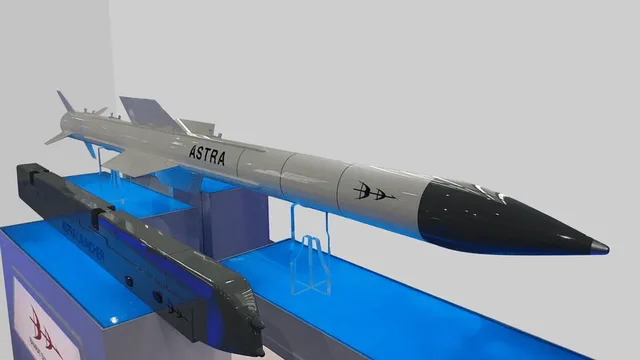
India's Astra Mk1 Upgrade: Enhancing Air-to-Air Capabilities
ADVERTISEMENT
SPONSORED
INDIGENOUS CNC SYSTEMS
Akriti Precision Systems — High-Precision Desktop CNC Milling
Made-in-India desktop CNC machines with composite superstructures, 15–25 µm repeatability & lifetime frame warranty. Built for aerospace, carbon fiber & precision prototyping.
Explore CNC Systems →India's Astra Mk1 Upgrade: Enhancing Air-to-Air Capabilities\n\nThe Defence Research and Development Organisation (DRDO) has announced plans to upgrade the Astra Mk1 beyond-visual-range air-to-air missile, extending its reported range from 110 km to around 160 km. This upgrade is significant, as it surpasses the range of the export version of China's PL-15, the PL-15E, which is commonly reported to have a range of around 145 km.\n\nAccording to statements attributed to Armament Research & Development Establishment (ARDE) Director Ankathi Raju, the Astra Mk1 has a publicly reported range of over 100 km. The missile is an active radar-guided beyond-visual-range air-to-air missile developed for the Indian Air Force and integrated with the Su-30MKI. It has also been tested from the indigenous Tejas fighter.\n\nThe proposed Mk1 enhancement would extend the missile's engagement envelope without the IAF having to wait for an entirely new missile generation. This is a strategic move, as longer-range weapons allow a fighter to have more options to engage hostile aircraft before it enters in an opponent's preferred firing envelope.\n\nHowever, the effectiveness of the Astra Mk1 upgrade depends on various factors, including the aircraft's ability to detect and track its target, retain the necessary targeting information, and support the missile in its engagement.\n\nThe Astra programme is also important for India's defence-industrial base. Its indigenous development and radar-seeker technology reduce reliance on imported air-to-air weapons while allowing further improvements to be pursued domestically.\n\nIn comparison, Pakistan's AIM-120C-5 AMRAAM missiles are generally assessed to have a shorter nominal range, while actual engagement envelopes depend heavily on the launch and target conditions.\n\nThe upgrade of the Astra Mk1 has significant implications for India's air-to-air capabilities, particularly in the context of the 2025 India-Pakistan conflict. The lessons drawn from this conflict have driven the DRDO to improve India's air-to-air engagement capability, and the Astra Mk1 upgrade is a key part of this effort.\n\nIn conclusion, the upgrade of the Astra Mk1 missile is a significant development in India's air-to-air capabilities, and it has the potential to enhance the country's defence-industrial base. As India continues to develop its air-to-air capabilities, the Astra Mk1 upgrade is an important step forward in this effort.
ADVERTISEMENT
SPONSORED
AEROSPACE COMPOSITES
Nanoweave Composites — Precision Engineered Carbon Fiber
Empowering aerospace, UAV defense & robotics with high-performance carbon fiber sheets, custom drone frames & precision CNC composite machining.
Explore Carbon Fiber →
ADVERTISEMENT
DEFENSE CAD/CAM SOFTWARE
Discover Takshak CAM →
Takshak CAM — Feature-Recognition CAM You Own Outright
Import STEP solids, automatically detect machinable features & post collision-checked 3-axis and 4-axis G-code. Perpetual license with zero recurring subscriptions.
Based on reporting from the original source. See our Copyright Policy for details.