Indian Air Force Chief Pushes for Separate Agencies to Streamline Aircraft Development Process
Akriti Precision Systems — High-Precision Desktop CNC Milling
Made-in-India desktop CNC machines with composite superstructures, 15–25 µm repeatability & lifetime frame warranty. Built for aerospace, carbon fiber & precision prototyping.
Explore CNC Systems →India's Aerospace Development Model Faces Crucial Test
The Indian Air Force (IAF) has been at the forefront of the country's ambitious aerospace development programme, with the development of indigenous aircraft such as the Tejas and the Advanced Medium Combat Aircraft (AMCA). However, the programme's success is now being threatened by the sheer scale and complexity of the projects being undertaken.
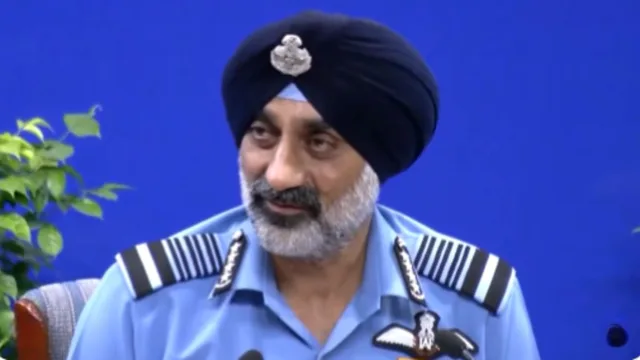
In a recent address, Air Chief Marshal AP Singh, the Chief of the Air Staff, highlighted the need for a more structured approach to the country's aerospace development model. Singh pointed out that the current model, which relies on a single Aeronautical Development Agency (ADA), is struggling to cope with the demands of multiple major aircraft programmes.
The Challenge of Multiple Programmes
The ADA is currently responsible for a range of aircraft programmes, including the Tejas variants, the AMCA, and the proposed Tejas Mk2. However, the sheer scale of these programmes is putting a strain on the organisation's resources. The Tejas Mk1A is now entering production, but the development of the Tejas Mk2 and the AMCA is still in its early stages.
Nanoweave Composites — Precision Engineered Carbon Fiber
Empowering aerospace, UAV defense & robotics with high-performance carbon fiber sheets, custom drone frames & precision CNC composite machining.
Explore Carbon Fiber →The Navy's requirement for a carrier-based fighter is adding another layer of complexity to the programme. Modern combat aircraft require large teams working simultaneously on a range of disciplines, including aerodynamics, structures, flight controls, avionics, electronic warfare, and flight testing.
The Case for a Second Design Organisation
Singh suggested that the solution to this problem could be to establish a second design organisation, which could focus on the development of strategic air systems. This organisation could work on programmes such as stealth Unmanned Combat Aerial Vehicles (UCAVs), Collaborative Combat Aircraft (CCA), and loyal-wingman systems.
This approach would allow one institution to focus purely on conventional fighter development, while another concentrates on more demanding strategic systems. The AAI could be retained as the primary combat-fighter design agency, responsible for programmes such as Tejas and its successors.
Shared Resources and Facilities
Establishing a second design organisation would not necessarily mean creating two completely independent DRDO empires. Shared facilities, wind tunnels, test ranges, certification infrastructure, and specialist laboratories could continue to support both organisations.
The DRDO already has a range of specialist organisations, including the Aeronautical Development Establishment (ADE), which works on unmanned air vehicles, and the Centre for Airborne Systems (CABS), which handles airborne surveillance systems. The Gas Turbine Research Establishment (GTRE) focuses on aero-engine technology.
International Comparison
The Indian aerospace development model is unique in the world. The United States, for example, uses government programme offices and a competitive industrial base, with companies such as Boeing, Lockheed Martin, and Northrop Grumman. The US Air Force has deliberately used competition and parallel development in programmes such as NGAD and CCA.
China has an extensive aviation design and research ecosystem under AVIC, with numerous research institutes and technology centres. Russia historically relied on multiple design bureaus, although these have since been consolidated under a UAC-level consolidation.
Key Takeaways
- The Indian Air Force has flagged the need for a more structured approach to the country's aerospace development model, with a focus on prioritisation and functional specialisation.
- The current model, which relies on a single Aeronautical Development Agency (ADA), is struggling to cope with the demands of multiple major aircraft programmes.
- Establishing a second design organisation could allow one institution to focus purely on conventional fighter development, while another concentrates on more demanding strategic systems.
- Shared facilities and resources could continue to support both organisations, reducing the need for duplication of effort and resources.
- A functional specialisation approach could allow India to develop a more efficient and effective aerospace development model, with a focus on the development of strategic air systems.
Takshak CAM — Feature-Recognition CAM You Own Outright
Import STEP solids, automatically detect machinable features & post collision-checked 3-axis and 4-axis G-code. Perpetual license with zero recurring subscriptions.
Based on reporting from the original source. See our Copyright Policy for details.