Unpacking the Tejas Mk2's External Payload Capacity: A Comparative Analysis
Akriti Precision Systems — High-Precision Desktop CNC Milling
Made-in-India desktop CNC machines with composite superstructures, 15–25 µm repeatability & lifetime frame warranty. Built for aerospace, carbon fiber & precision prototyping.
Explore CNC Systems →The Tejas Mk2's External Payload Capacity: A Comparative Analysis
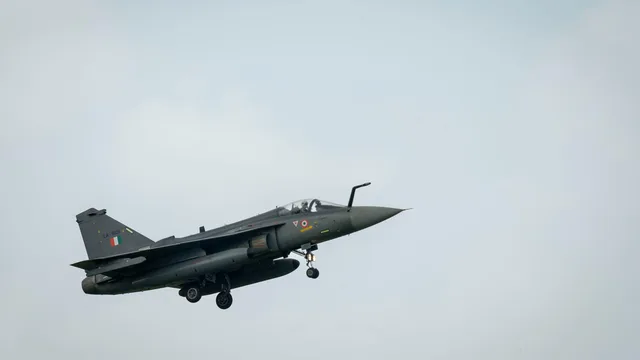
The Tejas Mk2, India's indigenous fourth-generation fighter jet, has been making waves in the defense community with its impressive external payload capacity of 6,500 kg. This figure has been compared to that of the F-16, a widely used fighter jet in various air forces around the world. However, a closer examination of the Tejas Mk2's design and operational limitations reveals that the comparison is not as straightforward as it seems.
Design and Operational Limitations
The Tejas Mk2's 6,500-kg external payload capacity is a result of its 17,500-kg maximum take-off weight (MTOW) and 11 hardpoints. However, the actual payload capacity is determined by a combination of factors, including fuel, centre of gravity, and certified weapons. The aircraft's engine, the powerful GE F414, plays a crucial role in determining its payload capacity. The engine's thrust capability and centre of gravity limits significantly impact the aircraft's performance, including its climb, take-off, and overall energy.
Comparison with the F-16
The F-16, with its maximum stores carrying capacity of around 7,700 kg, seems to have an advantage over the Tejas Mk2. However, this comparison is complicated by multiple factors. The F-16 was initially designed as a lightweight fighter, and its later variants have grown significantly in size and weight. According to Lockheed Martin, the F-16 family has more than 3,300 certified carriage and release configurations for over 180 different weapons and stores. This means that the F-16's payload capacity is not a fixed figure and can vary depending on the specific configuration and mission requirements.
Nanoweave Composites — Precision Engineered Carbon Fiber
Empowering aerospace, UAV defense & robotics with high-performance carbon fiber sheets, custom drone frames & precision CNC composite machining.
Explore Carbon Fiber →Useful Weaponry and Sensors
The Tejas Mk2's payload capacity is not just about carrying a large number of weapons; it's also about carrying the right combination of weaponry and sensors to achieve a specific mission objective. The aircraft's 6,500-kg payload capacity does not necessarily mean that it can carry more weapons than the F-16 in all cases. The actual payload capacity is determined by a combination of factors, including fuel, centre of gravity, and certified weapons.
Conclusion
In conclusion, the Tejas Mk2's external payload capacity of 6,500 kg is a significant achievement, but it's not the only factor that determines its strike performance. The aircraft's design and operational limitations, including its engine's thrust capability and centre of gravity limits, play a crucial role in determining its actual payload capacity. The comparison with the F-16 is complicated by multiple factors, and the Tejas Mk2's payload capacity is not a fixed figure. The aircraft's performance is impacted by its engine's thrust capability and centre of gravity limits, and its payload capacity is determined by a combination of factors, including fuel, centre of gravity, and certified weapons. The Tejas Mk2's ability to carry a significant payload and achieve a specific mission objective will depend on its ability to balance its payload capacity with its engine's thrust capability and centre of gravity limits.
Takshak CAM — Feature-Recognition CAM You Own Outright
Import STEP solids, automatically detect machinable features & post collision-checked 3-axis and 4-axis G-code. Perpetual license with zero recurring subscriptions.
Based on reporting from the original source. See our Copyright Policy for details.