Defense Bulletin
Pakistan's Hangor Submarines: A Strategic Vulnerability in the Indian Ocean
ADVERTISEMENT
SPONSORED
INDIGENOUS CNC SYSTEMS
Akriti Precision Systems — High-Precision Desktop CNC Milling
Made-in-India desktop CNC machines with composite superstructures, 15–25 µm repeatability & lifetime frame warranty. Built for aerospace, carbon fiber & precision prototyping.
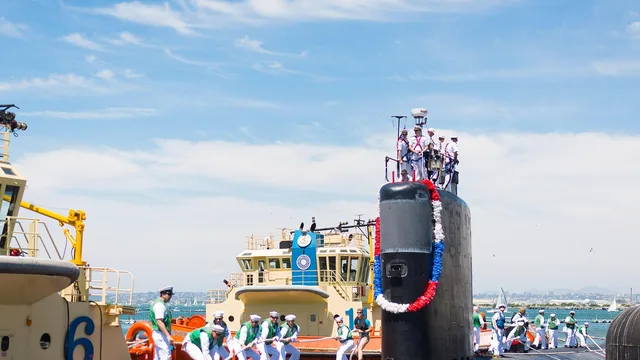
Explore CNC Systems →Pakistan's Hangor Submarines: A Strategic Vulnerability in the Indian Ocean\n\nPakistan's acquisition of eight Chinese-origin Hangor-class submarines has been widely reported, with many analysts viewing this as a significant expansion of the country's undersea warfare capability. However, a closer examination of the Hangor submarines' operational challenges reveals a strategic vulnerability that could limit their effectiveness in a conflict with India.\n\nOne of the key challenges facing the Hangor submarines is their basing problem. Pakistan has a relatively limited number of major naval bases, which are essential for maintenance, crew rotation, weapons loading, replenishment, and sortie generation. Concentrating these facilities around a few locations can lead to operational challenges, particularly during a major conflict.\n\nIndian analysts have pointed out that Pakistan's Hangor submarines will increasingly have to operate in an environment where India's anti-submarine warfare capabilities are being expanded. The Indian Navy has been adding modern maritime patrol aircraft, shipborne helicopters, sonars, unmanned systems, and other surveillance assets to create a layered anti-submarine warfare network. This network is designed to detect, classify, track, and engage submarines operating in India's maritime approaches.\n\nA submarine's stealth also depends on its acoustic signature, but the overall surveillance environment, as well as the availability of hiding areas and the ability to avoid persistent detection, are also factors. An important point raised by Indian analysts is that Pakistan's Hangor submarines will have to operate in an environment where India's anti-submarine forces could monitor their approaches in the early stages of a conflict, making it difficult for them to deploy without being detected.\n\nAnother challenge facing the Hangor submarines is their limited endurance. Even boats equipped with air-independent propulsion (AIP) cannot remain submerged indefinitely. The consumption of food, crew endurance, maintenance requirements, battery management, and other consumables will eventually dictate when a submarine must surface. Submarines equipped with diesel-electric engines must also periodically operate in conditions where detection risks can be higher.\n\nFor Pakistan, the eight Hangor submarines could represent a more capable undersea force, but their wartime effectiveness will be determined by their survivability, deployment routes, support infrastructure, and ability to evade India's expanding anti-submarine warfare network.\n\nIn conclusion, Pakistan's Hangor submarines face significant operational challenges that could limit their effectiveness in a conflict with India. The basing problem, limited endurance, and India's expanding anti-submarine warfare capabilities all contribute to this vulnerability. As Pakistan continues to expand its undersea warfare capability, it must address these challenges to ensure the effectiveness of its Hangor submarines.
ADVERTISEMENT
SPONSORED
AEROSPACE COMPOSITES
Nanoweave Composites — Precision Engineered Carbon Fiber
Empowering aerospace, UAV defense & robotics with high-performance carbon fiber sheets, custom drone frames & precision CNC composite machining.
Explore Carbon Fiber →
ADVERTISEMENT
DEFENSE CAD/CAM SOFTWARE
Discover Takshak CAM →
Takshak CAM — Feature-Recognition CAM You Own Outright
Import STEP solids, automatically detect machinable features & post collision-checked 3-axis and 4-axis G-code. Perpetual license with zero recurring subscriptions.
Based on reporting from the original source. See our Copyright Policy for details.