India's VL-SRSAM Missile Exports to Gain Momentum with Proven Astra Technology Backbone
Akriti Precision Systems — High-Precision Desktop CNC Milling
Made-in-India desktop CNC machines with composite superstructures, 15–25 µm repeatability & lifetime frame warranty. Built for aerospace, carbon fiber & precision prototyping.
Explore CNC Systems →India's Missile Technology Eyes Global Markets
The Indian defence industry has been making significant strides in recent years, with the country's missile technology gaining recognition globally. The success of the Astra missile, which was used in combat for the first time during Operation Sindoor in May 2025, has opened up new avenues for Indian missile exports. The Indonesian government signed an agreement with Bharat Dynamics Limited in July 2026 to procure the Astra missile, marking the first foreign sale of the Indian missile.
The Rise of VL-SRSAM
The Vertical Launch Short Range Surface-to-Air Missile (VL-SRSAM) is another Indian missile that is poised to make a significant impact on the global market. Developed by the Defence Research and Development Organisation (DRDO), the VL-SRSAM is a quick reaction surface-to-air missile system that leverages the proven technology of the Astra Mk-1 air-to-air missile. The missile features four short span long chord cruciform wings, providing the necessary aerodynamic stability and jet vane control surfaces for rapid response on the vertical launch with smokeless exhaust.
Key Features of VL-SRSAM
- The missile has a length of 3.8 metres and weighs 170 kg.
- It carries a 15 kg high explosive pre-fragmented warhead with radio proximity fuze.
- Mid-course guidance is provided by fibre-optic-gyroscope based inertial navigation system with active radar homing in the terminal phase.
- The system offers 360-degree interception capability and is capable of countering a broad range of aerial targets at medium and close ranges.
Enhanced Range and Capabilities
Recent reports suggest that the range of the VL-SRSAM has been doubled to around 80 kilometres, with an altitude of up to 16 km. This upgrade has put the system well into the medium-range air defence category. With its potential range optimisation, the VL-SRSAM could potentially match the ranges of the Astra Mk-1 air-to-air missile. While the surface-launched missile cannot match the range of an air-launched missile, adapting some of the trajectory optimisation and energy management principles used for the Astra could allow the VL-SRSAM to reach similar ranges.
Nanoweave Composites — Precision Engineered Carbon Fiber
Empowering aerospace, UAV defense & robotics with high-performance carbon fiber sheets, custom drone frames & precision CNC composite machining.
Explore Carbon Fiber →Complementing the MRSAM System
At an effective range of around 70-80 km, the VL-SRSAM's high engagement density thanks to the quad-pack would greatly complement the MRSAM (Barak-8) medium-range system. A single vertical launching cell of the Visakhapatnam class destroyers can hold four VL-SRSAM missiles compared to one MRSAM missile, potentially allowing a much higher number of simultaneous engagements with anti-ship missiles or UAVs at comparable ranges.
Export Potential
The VL-SRSAM system is seeing significant interest from several export customers, benefiting from the confidence inspired by the combat use of the Astra missiles. The system's potential customers are likely to be attracted by its combat-proven status, lower costs, and less political burden compared to Western manufacturers. The indigenous design, proven aerodynamics, and high engagement density per launcher make it a highly desirable option for foreign navies with Indian-built ships or considering purchasing them.
Induction and Future Plans
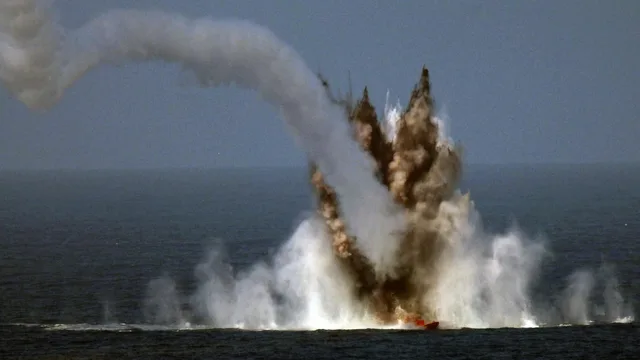
The VL-SRSAM system development has reached the final stage ahead of induction. The flight test conducted on 26 Mar 2025 from the Integrated Test Range, Chandipur, demonstrated the capability of the system to engage near-boundary, low-flying targets (sea-skimming anti-ship missiles). The system is set to become the main point-defence missile system for the Navy's upcoming Next-Generation Missile Vessels (NGMVs) and Next-Generation Corvettes (NGCs) and is considering for the requirements of the Indian Air Force as well. The Ministry of Defence is also planning an integrated multi-layer air defence network for the National Capital Region ("Capital Dome") which will include the VL-SRSAM as well.
Key Takeaways
- The VL-SRSAM system has the potential to become a game-changer in the global missile market, with its combat-proven status, lower costs, and less political burden.
- The system's high engagement density and 360-degree interception capability make it an attractive option for foreign navies with Indian-built ships or considering purchasing them.
- The VL-SRSAM system is set to become the main point-defence missile system for the Navy's upcoming Next-Generation Missile Vessels (NGMVs) and Next-Generation Corvettes (NGCs) and is considering for the requirements of the Indian Air Force as well.
Takshak CAM — Feature-Recognition CAM You Own Outright
Import STEP solids, automatically detect machinable features & post collision-checked 3-axis and 4-axis G-code. Perpetual license with zero recurring subscriptions.
Based on reporting from the original source. See our Copyright Policy for details.