India's Vikrant-Class Carrier Upgrade: A Cost-Effective Leap Forward in Naval Aviation
India's Vikrant-Class Carrier Upgrade: A Cost-Effective Leap Forward in Naval Aviation
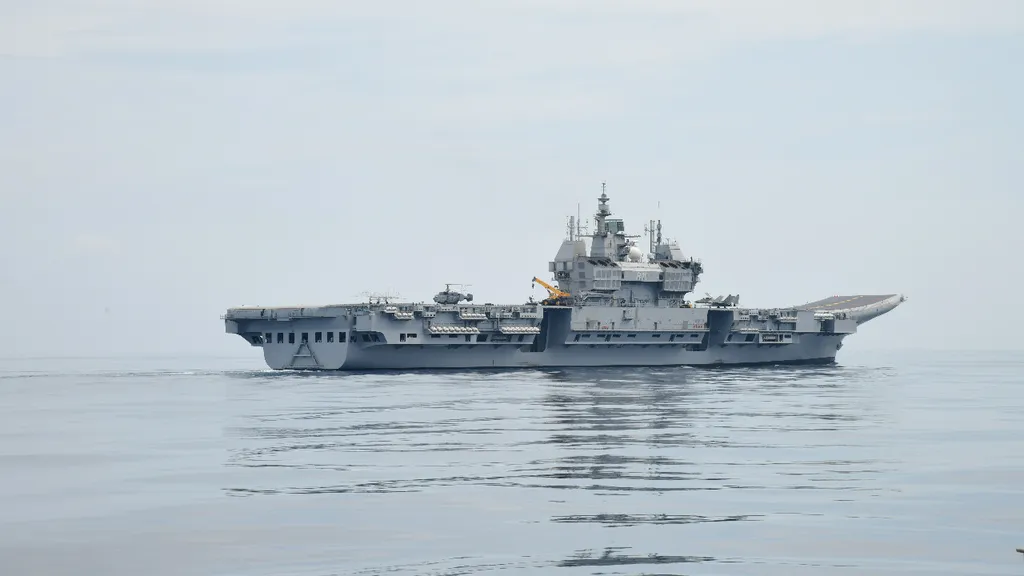
The Indian Navy is set to embark on a significant upgrade to its Vikrant-class aircraft carrier program, with the second vessel in the class expected to feature cutting-edge design modifications for unmanned aerial systems. While the estimated cost of the second carrier is projected to rise by $300-500 million over the cost of INS Vikrant, the first-in-class carrier already commissioned into the Indian Navy, the cost remains relatively contained.
The repeat-hull strategy, which involves building a second 45,000-tonne carrier derived closely from the Vikrant design, is attributed to the contained cost growth. By reusing a proven design, the Navy can avoid extensive engineering and design-iteration costs, which made INS Vikrant's own development so lengthy and expensive relative to its final displacement.
The second Vikrant-class carrier, widely referred to as IAC-2, is expected to give India a second indigenously built carrier roughly a decade sooner than its predecessor, relative to its build time. This represents a significant leap forward in naval aviation for the Indian Navy, with the second carrier's design being reworked to accommodate next-generation unmanned systems, including deck-based unmanned combat aerial vehicles drawn from programs like DRDO's Ghatak, alongside HALE-class UAVs capable of extended maritime surveillance and sensor coverage.
The upgraded flight deck and hangar arrangements on the second carrier will be designed to handle unmanned platforms, while the command and control systems will be updated to manage mixed manned-unmanned air operations. This represents a major step forward in the Navy's efforts to integrate unmanned combat aviation into carrier strike group operations.
The cost of INS Vikrant, which was built by Cochin Shipyard Limited, was approximately ₹20,000 crore to ₹23,000 crore, translating to roughly $2.5 billion to $2.7 billion. The second carrier's cost is expected to remain relatively modest, with a 20% increase over INS Vikrant's higher-end cost estimate. This represents a significant achievement for the Indian Navy, which has been working to secure formal government approval for IAC-2 during 2026.
The Defence Procurement Board has vetted a broadly similar proposal in the ₹40,000 crore range before the UAV-focused redesign was layered in. If the current cost and timeline projections hold, IAC-2 would give India a second indigenously built carrier roughly a decade sooner, relative to its predecessor's build time, while also representing the Navy's first serious operational step toward integrating unmanned combat aviation into carrier strike group operations.
A Leap Forward in Naval Aviation
The Indian Navy's decision to upgrade its Vikrant-class aircraft carrier program represents a significant leap forward in naval aviation. By incorporating design modifications for unmanned aerial systems, the second carrier will be capable of operating next-generation unmanned platforms, including deck-based unmanned combat aerial vehicles and HALE-class UAVs.
A Cost-Effective Upgrade
The estimated cost of the second carrier is projected to rise by $300-500 million over the cost of INS Vikrant. While this represents a significant increase, the cost remains relatively contained, with a 20% increase over the first ship's higher-end cost estimate.
A Proven Design
The repeat-hull strategy, which involves building a second 45,000-tonne carrier derived closely from the Vikrant design, is attributed to the contained cost growth. By reusing a proven design, the Navy can avoid extensive engineering and design-iteration costs, which made INS Vikrant's own development so lengthy and expensive relative to its final displacement.
A Significant Achievement
The Indian Navy's decision to upgrade its Vikrant-class aircraft carrier program represents a significant achievement for the country's naval aviation capabilities. By incorporating design modifications for unmanned aerial systems, the second carrier will be capable of operating next-generation unmanned platforms, including deck-based unmanned combat aerial vehicles and HALE-class UAVs.
Key Takeaways
- The estimated cost of the second Vikrant-class carrier is projected to rise by $300-500 million over the cost of INS Vikrant.
- The repeat-hull strategy, which involves building a second 45,000-tonne carrier derived closely from the Vikrant design, is attributed to the contained cost growth.
- The second Vikrant-class carrier is expected to give India a second indigenously built carrier roughly a decade sooner than its predecessor, relative to its build time.
- The upgraded flight deck and hangar arrangements on the second carrier will be designed to handle unmanned platforms.
- The command and control systems will be updated to manage mixed manned-unmanned air operations.
Based on reporting from the original source. See our Copyright Policy for details.