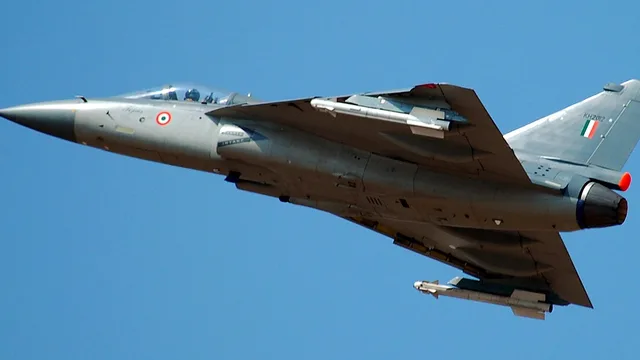
India's Tejas Mk2 Takes a Giant Leap Forward with Meteor Clearance and Indigenous Radar Upgrade
India Defence & Aerospace Indigenisation Summit 2026
Accelerating private defense manufacturing, UAV innovation, and strategic aerospace corridors.
Explore Strategic Intel →India's Tejas Mk2 programme has reached a critical juncture, with the aircraft's indigenous Uttam AESA radar transitioning from an initial gallium arsenide build to a gallium nitride production standard. This upgrade offers significant improvements in peak power output, heat dissipation, and resistance to jamming. The radar's new production standard will provide the Tejas Mk2 with a critical advantage in combat situations.
But the most significant development in the Tejas Mk2 programme lies in its weapons architecture. The aircraft has been cleared to carry the MBDA Meteor beyond-visual-range missile, a game-changing weapon that offers unmatched speed and range. Meteor's ramjet-powered speed and sustained no-escape zone make it the perfect complement to the Tejas Mk2's advanced radar system. Until India's own Astra Mk3 arrives in numbers, Meteor is expected to serve as the aircraft's top-tier stand-off weapon.
The integration of Meteor on the Tejas Mk2 marks a significant shift in India's defense capabilities. MBDA has historically been guarded about pairing Meteor with non-European radar and fire-control architectures, given the sensitivity of the missile's encrypted datalink and guidance software. However, the consortium's willingness to work with Tejas variants running a locally built radar marks a major breakthrough.
India Defence & Aerospace Indigenisation Summit 2026
Accelerating private defense manufacturing, UAV innovation, and strategic aerospace corridors.
Explore Strategic Intel →The Tejas Mk2's weapons stack is expected to be a formidable combination of indigenous and imported systems. The Astra family, including the Astra Mk1 and Astra Mk2 extended-range variants, will form the backbone of the Tejas Mk2's BVR loadout for day-to-day operations. These missiles offer a fully indigenous option that does not depend on European end-user restrictions.
But the real star of the show is the Astra Mk3, a ramjet-powered missile designed to exceed 300 kilometres and compete directly with Meteor's performance envelope. Although the Astra Mk3 remains considerably further from service, its development is expected to have a significant impact on India's defense capabilities. The missile has yet to complete flight testing, and industry sourcing suggests the programme is roughly five years from a production clearance.
As the Tejas Mk2 programme continues to accelerate, it is clear that India's air force is on the cusp of a major upgrade. With the cutting-edge Uttam AESA radar and the game-changing Meteor beyond-visual-range missile on board, the Tejas Mk2 is poised to take on the best in the region. The integration of Meteor on the Tejas Mk2 marks a significant shift in India's defense capabilities, and the Astra family is expected to play a critical role in the aircraft's BVR loadout.
The Tejas Mk2's indigenous Uttam AESA radar is a critical component of the aircraft's advanced radar system. The radar's gallium nitride production standard offers significant improvements in peak power output, heat dissipation, and resistance to jamming. This upgrade will provide the Tejas Mk2 with a critical advantage in combat situations.
The integration of Meteor on the Tejas Mk2 marks a significant shift in India's defense capabilities. MBDA's willingness to work with Tejas variants running a locally built radar marks a major breakthrough. Until India's own Astra Mk3 arrives in numbers, Meteor is expected to serve as the aircraft's top-tier stand-off weapon.
The Astra family, including the Astra Mk1 and Astra Mk2 extended-range variants, will form the backbone of the Tejas Mk2's BVR loadout for day-to-day operations. These missiles offer a fully indigenous option that does not depend on European end-user restrictions.
Key Takeaways
- The Tejas Mk2 programme has reached a critical juncture, with the aircraft's indigenous Uttam AESA radar transitioning from an initial gallium arsenide build to a gallium nitride production standard.
- The integration of Meteor on the Tejas Mk2 marks a significant shift in India's defense capabilities, with the missile offering unmatched speed and range.
- The Astra family, including the Astra Mk1 and Astra Mk2 extended-range variants, will form the backbone of the Tejas Mk2's BVR loadout for day-to-day operations.
- The Astra Mk3, a ramjet-powered missile designed to exceed 300 kilometres and compete directly with Meteor's performance envelope, remains considerably further from service.
- The Tejas Mk2 programme is expected to have a significant impact on India's defense capabilities, with the aircraft poised to take on the best in the region.
India Defence & Aerospace Indigenisation Summit 2026
Accelerating private defense manufacturing, UAV innovation, and strategic aerospace corridors.
Based on reporting from the original source. See our Copyright Policy for details.