India's Tejas Mk1A Secures Future with GE F404-IN20 Engine: A Strategic Choice for National Security
India Defence & Aerospace Indigenisation Summit 2026
Accelerating private defense manufacturing, UAV innovation, and strategic aerospace corridors.
Explore Strategic Intel →India's Tejas Mk1A Secures Future with GE F404-IN20 Engine: A Strategic Choice for National Security
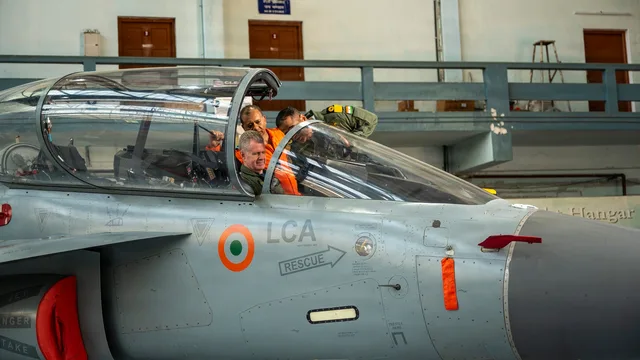
The Indian Air Force's (IAF) decision to choose the GE F404-IN20 engine for the Tejas Mk1A fighter jet has been met with curiosity and scrutiny. The choice of engine was not based on thrust or integration, but rather on reliability, maintenance, and support. The IAF prioritized these factors, recognizing the importance of a reliable engine in maintaining squadron strength.
The Russian RD-33 engine, which was considered as an alternative, has a reputation for being maintenance-intensive. The engine's overhaul period is notoriously short, consuming flying hours and straining squadron strength. This was a significant concern for the IAF, as it would impact the overall operational readiness of the fleet. In contrast, the GE F404-IN20 engine offers predictable sortie generation, a crucial factor for a light fighter that must form the backbone of the Indian Air Force.
The IAF's decision was also influenced by the experiences of other countries that have used the RD-33 engine. Pakistan's JF-17 fleet, which uses the RD-93 variant of the RD-33 engine, has been plagued by issues. More than 40 Block 1 and Block 2 JF-17s have been grounded and determined to be unairworthy, with cracks appearing in the guide vanes, exhaust nozzles, and flame stabilisers. While the exact extent of these issues is unclear, due to Pakistan's lack of transparency regarding fleet-wide serviceability figures, the nature of the engine faults is concerning.
India Defence & Aerospace Indigenisation Summit 2026
Accelerating private defense manufacturing, UAV innovation, and strategic aerospace corridors.
Explore Strategic Intel →India's choice of the GE F404-IN20 engine is a strategic one, prioritizing the stability and efficiency of its air force. By selecting a reliable engine with a proven track record, the IAF has ensured that its Tejas Mk1A fleet will be able to maintain a high level of operational readiness, a critical factor in maintaining national security.
Setting Up for Success: The IAF's In-Country Repair Depot
To address the issue of supplier dependence, the IAF is setting up its own in-country F404-IN20 repair depot. GE will provide technical support, training, and spares to break India's dependence on sending engines overseas for repair. This move will not only reduce the turnaround time for repairs but also enhance the overall reliability of the engine.
The Kaveri Derivative Programme: A Long-Term Solution
While the GE F404-IN20 engine provides a reliable powerplant for the Tejas Mk1A, the IAF is also exploring the development of an indigenous engine. The Kaveri derivative programme aims to create a class of engines with a thrust range of 110-120kN. This programme has the potential to address both the reliability and supplier dependence issues simultaneously.
Conclusion
The IAF's decision to choose the GE F404-IN20 engine for the Tejas Mk1A fighter jet is a strategic one, prioritizing the stability and efficiency of its air force. By selecting a reliable engine with a proven track record, the IAF has ensured that its Tejas Mk1A fleet will be able to maintain a high level of operational readiness, a critical factor in maintaining national security. The IAF's long-term goal of developing an indigenous engine, such as the Kaveri derivative programme, will further enhance the reliability and efficiency of its fleet.
Key Takeaways
- The IAF's decision to choose the GE F404-IN20 engine for the Tejas Mk1A fighter jet was based on reliability, maintenance, and support.
- The Russian RD-33 engine has a reputation for being maintenance-intensive, with a notoriously short overhaul period.
- The IAF's decision was influenced by the experiences of other countries that have used the RD-33 engine, including Pakistan's JF-17 fleet.
- The IAF is setting up its own in-country F404-IN20 repair depot to reduce supplier dependence and enhance reliability.
- The Kaveri derivative programme aims to create a class of engines with a thrust range of 110-120kN, addressing both reliability and supplier dependence issues simultaneously.
India Defence & Aerospace Indigenisation Summit 2026
Accelerating private defense manufacturing, UAV innovation, and strategic aerospace corridors.
Based on reporting from the original source. See our Copyright Policy for details.