India's Strategic Edge: The Unseen Fuel Penalty Behind Its Long-Range Missiles
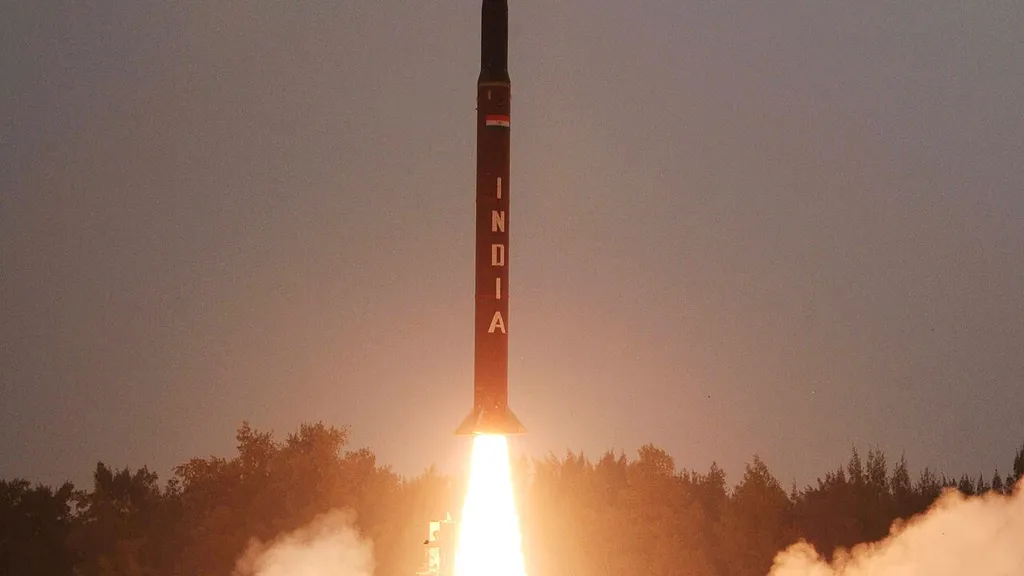
India's strategic missile programme has long been a subject of fascination and admiration, with its Agni family of long-range ballistic missiles consistently pushing the boundaries of what's thought possible. But behind the impressive headlines and precision-guided munitions lies a complex web of technical and diplomatic challenges that must be navigated every time a new Agni variant is readied for a full-distance trial.
One of the key factors that sets India's Agni programme apart from its international counterparts is its deliberate design philosophy. This approach prioritizes the ability to test genuine intercontinental-class trajectories without sparking diplomatic tensions, even if it means sacrificing up to 30% of the missile's fuel budget. This calculated risk is made possible by a built-in performance margin that's designed to absorb the fuel penalty from avoidance manoeuvres.
The Agni programme's DNA has been shaped by this philosophy since its earliest demonstrator flights in the early 1990s. Back then, DRDO first introduced manoeuvring capability to validate re-entry accuracy, and over successive Agni variants, that same manoeuvring capacity has doubled as a geopolitical safeguard. Today, India's strategic missile programme is a testament to the country's commitment to developing a credible deterrent without compromising regional diplomatic sensitivities.
So, what's the significance of this built-in performance margin? For a nuclear-capable deterrent system, it matters strategically as well as technically. An operational missile fired in an actual conflict scenario would not need to detour around foreign airspace and could in theory fly a straighter, more fuel-efficient path, extending its effective reach beyond what's demonstrated in test conditions. This margin is a quiet but essential part of how India demonstrates deterrent credibility without provoking unnecessary friction with neighbouring states during test operations.
The gap between a publicly tested range figure and a missile's true engineering ceiling is a complex issue that's rarely discussed in public. However, former DRDO Chairman S Christopher's disclosure has shed rare light on this topic, offering a window into the operational discipline behind India's missile test regime. According to Christopher, the fuel expenditure from avoidance manoeuvres is substantial enough that it would compromise range on a less conservatively engineered system.
The challenge of testing long-range missiles in a geographically constrained environment is a significant one. India's missile test corridor over the Bay of Bengal is flanked by the airspace and territorial claims of neighbouring and nearby states. When DRDO conducts a full-range test of an Agni-series missile, mission planners cannot simply fire along the shortest great-circle path if that path risks overflying a third country's sovereign airspace or drifting close to busy international shipping and aviation lanes.
In this context, the Agni programme's manoeuvring re-entry vehicle technology has been a game-changer. By incorporating this margin, India can test genuine intercontinental-class trajectories without triggering diplomatic friction over airspace violations. This design philosophy has been a key factor in the Agni programme's success, allowing India to maintain its strategic edge while avoiding unnecessary tensions with its neighbours.
As India continues to expand its Agni-V and future Agni-VI or intercontinental-class programmes, this built-in performance cushion is likely to remain a quiet but essential part of how the country demonstrates deterrent credibility. By prioritizing technical validation against regional diplomatic sensitivities, India's strategic missile programme has set a new standard for the region. And as the Agni programme continues to push the boundaries of what's possible, one thing is clear: India's commitment to developing a credible deterrent is unwavering, and its strategic edge is here to stay.
Based on reporting from the original source. See our Copyright Policy for details.