Defense Bulletin
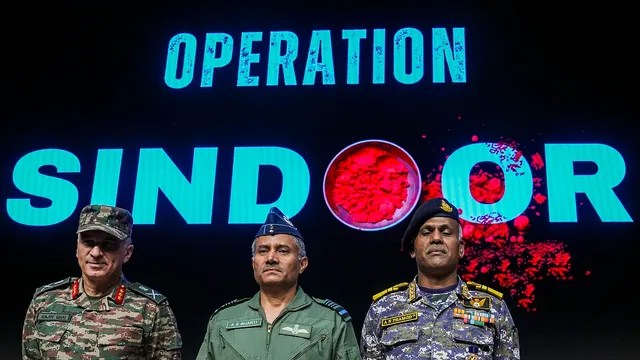
India's Operation Sindoor: A Catalyst for French Air Combat Advancements
ADVERTISEMENT
SPONSORED
INDIGENOUS CNC SYSTEMS
Akriti Precision Systems — High-Precision Desktop CNC Milling
Made-in-India desktop CNC machines with composite superstructures, 15–25 µm repeatability & lifetime frame warranty. Built for aerospace, carbon fiber & precision prototyping.
Explore CNC Systems →India's Operation Sindoor: A Catalyst for French Air Combat Advancements\n\nIn a significant development, France has been studying India's Operation Sindoor, a massive air operation that offered valuable lessons to European air forces. The Indian Air Force's experiences during this campaign have piqued the interest of French officials, who are eager to learn from India's combat tactics, particularly its electronic warfare strategies.\n\nFrench Air and Space Force Vice-Chief Lieutenant General Dominique Tardif, who was visiting India to observe Tarang Shakti 2026, revealed that France is studying India's experimental experience, especially the dense concentration of aircraft operating in the same battlespace. This, he noted, is something Western air forces have not experienced at such a scale since the Second World War.\n\nHowever, French interest in India's combat experience goes beyond the larger operational lessons of the conflict. According to sources, France has expressed an interest in India's use of recoverable Chinese-origin PL-15E surface-attack air-to-air missile parts, specifically the missile's seeker, guidance architecture, and associated electronic systems.\n\nIndia recovered debris of the PL-15 missile in operation, while later reports indicated that relatively intact parts, including hardware associated with the missile's seeker system, were available for technical analysis. The detection of an intact PL-15E could provide an opportunity to evaluate its Chinese AESA seeker technology.\n\nLater reports have said that Indian teams extracted electronic-system-related data regarding its characteristics and guidance architecture. If France gets access to such data, it could find useful applications in electronic-warfare and missile-technology development activities.\n\nThe use of the PL-15E during Operation Sindoor has attracted a lot of interest as BVR combat relies heavily on electronic warfare. Indian defense sources have stated that the inability of several Pakistani-fired PL-15Es to hit their targets was due to India's electronic warfare activity and the PAF's employment tactics.\n\nTardif also confirmed that France is encouraging MBDA to develop a longer-range air-to-air missile. He also said that France was monitoring systems like the PL-15 and R-37, and has put pressure on MBDA to develop a more capable and longer-range missile quickly.\n\nIndia Strategic\n\nThis requirement directly relates to the combat architecture planned for the future Rafale fleet. While France and India both operate the MBDA Meteor missile, the advent of Chinese and Russian longer-range systems is spurring interest in next-generation air-to-air missile systems.\n\nFor India, studying French analysis of PL-15E technology could have broader implications beyond France, especially as India acquires larger numbers of Rafales and develops greater indigenous capabilities in electronic warfare.\n\nThe French interest thus could be an important avenue of aviation cooperation: Indian combat experience and data on foreign missile systems could inform the evolution of French missile and EW systems, while French expertise and systems analysis could help shape the future of India's future fleet of Rafales and the combat aviation ecosystem.\n\nIn conclusion, India's Operation Sindoor has emerged as a significant catalyst for French air combat advancements, offering valuable lessons in electronic warfare and missile technology development. As France continues to study and learn from India's experiences, it is likely that the two nations will strengthen their aviation cooperation, leading to enhanced air combat capabilities for both countries.
ADVERTISEMENT
SPONSORED
AEROSPACE COMPOSITES
Nanoweave Composites — Precision Engineered Carbon Fiber
Empowering aerospace, UAV defense & robotics with high-performance carbon fiber sheets, custom drone frames & precision CNC composite machining.
Explore Carbon Fiber →
ADVERTISEMENT
DEFENSE CAD/CAM SOFTWARE
Discover Takshak CAM →
Takshak CAM — Feature-Recognition CAM You Own Outright
Import STEP solids, automatically detect machinable features & post collision-checked 3-axis and 4-axis G-code. Perpetual license with zero recurring subscriptions.
Based on reporting from the original source. See our Copyright Policy for details.