India's Maritime Powerhouse: Strengthening HSL's Capacity and Indigenous Capability
Akriti Precision Systems — High-Precision Desktop CNC Milling
Made-in-India desktop CNC machines with composite superstructures, 15–25 µm repeatability & lifetime frame warranty. Built for aerospace, carbon fiber & precision prototyping.
Explore CNC Systems →India's Maritime Powerhouse: Strengthening HSL's Capacity and Indigenous Capability
Raksha Mantri Shri Rajnath Singh's recent visit to Hindustan Shipyard Limited (HSL) marked a significant milestone in India's journey towards strengthening its indigenous maritime capability. The launch of the first Fleet Support Ship (FSS-1), the laying of the keel of the fifth FSS, and the inauguration of the upgraded Slipway-4 and 300-tonne Goliath Crane are testaments to HSL's growing capacity and India's commitment to self-reliance.
The FSS-1, named 'Surya', is a symbol of achievement, while the keel laying of FSS-5 represents a symbol of resolve. The upgraded Slipway-4, with its advanced features and capabilities, is a symbol of growing capability. These milestones are not just individual achievements but also reflect HSL's transformation and sustained efforts towards becoming a leading shipbuilding facility in the country.
HSL's journey towards becoming a Miniratna Category-I status in 2025 is a testament to its transformation and commitment to excellence. The facility has been a custodian of India's national maritime capability for over eight decades, contributing significantly to the country's maritime and defence requirements. The launch of FSS-1 and the keel laying of FSS-5 are significant steps towards strengthening the Navy's reach, endurance, and operational effectiveness in the Indian Ocean Region.
Nanoweave Composites — Precision Engineered Carbon Fiber
Empowering aerospace, UAV defense & robotics with high-performance carbon fiber sheets, custom drone frames & precision CNC composite machining.
Explore Carbon Fiber →Fleet Support Ships are essential for a Navy operating in distant maritime areas, providing at-sea replenishment and sustained support to naval operations. The FSS-1 and FSS-5 will feature enhanced cargo and fluid capacity, onboard first-line maintenance workshops, a helicopter deck for Multi-Role Helicopter operations, and self-defence systems. These advanced features will enable the Navy to operate more effectively and efficiently in the Indian Ocean Region.
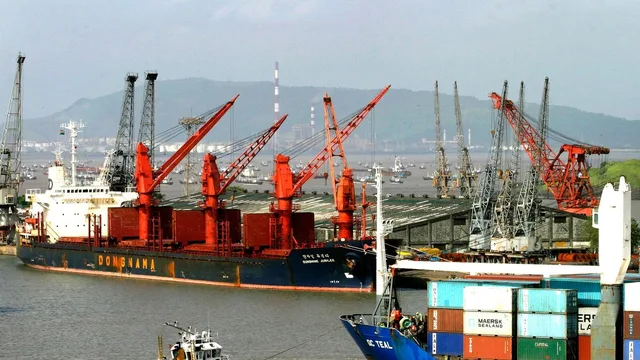
The upgraded Slipway-4 has been extended and strengthened to enable HSL to build and launch ships of up to 45,000 DWT. The 300-tonne Goliath Crane, designed and manufactured by M/s L&T Geostructure with Konecranes under Make in India, will enable faster and more precise handling of heavier blocks for modern block construction. This advanced infrastructure will strengthen HSL's ability to undertake larger and more complex shipbuilding programmes.
Raksha Mantri Shri Rajnath Singh emphasized the need for Indian shipyards to become more closely integrated with the country's wider industrial ecosystem. He called for HSL to become a major Maritime Industrial Hub by bringing together naval expertise, shipbuilding capability, engineering talent, port infrastructure, and skilled manpower. The objective should be to develop a complete shipbuilding ecosystem around HSL, supported by logistics, port infrastructure, research, technology, and skilled manpower.
The Raksha Mantri also stressed the need for an integrated national maritime ecosystem involving the Navy, HSL, DRDO, academia, industry, MSMEs, and startups. He highlighted that India's maritime strength cannot be built by the Navy or shipyards alone and called for greater integration among all stakeholders. The goal should be simple and clear: Design better, build faster, deliver on time, operate efficiently, and maintain effectively.
India's defence manufacturing ecosystem has undergone significant transformation over the past decade, with increasing focus on domestic design and manufacture of sophisticated systems and platforms. Timely delivery, productivity, indigenous design capability, supply chain resilience, skilled manpower, capacity, and cost competitiveness are key areas that will determine India's ability to convert its shipbuilding potential into global competitiveness.
In conclusion, the launch of FSS-1 and the keel laying of FSS-5 are significant milestones in India's journey towards strengthening its indigenous maritime capability. HSL's growing capacity and India's commitment to self-reliance will enable the country to become a major player in the global shipbuilding industry. With a focus on design, build, delivery, operation, and maintenance, India can achieve its goal of becoming a maritime powerhouse.
Takshak CAM — Feature-Recognition CAM You Own Outright
Import STEP solids, automatically detect machinable features & post collision-checked 3-axis and 4-axis G-code. Perpetual license with zero recurring subscriptions.
Based on reporting from the original source. See our Copyright Policy for details.