India's Artillery Dilemma: Can the Country Close the Gap with China's Self-Propelled Might?
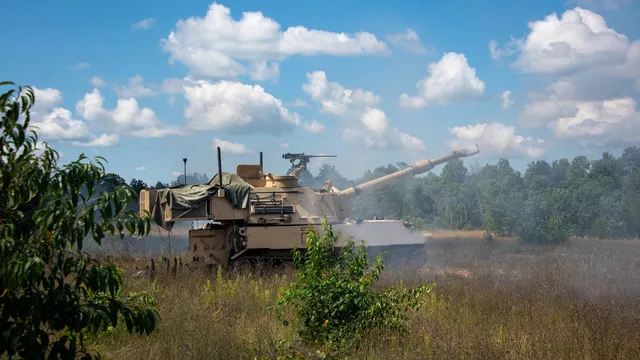
India's self-propelled artillery fleet is a fraction of China's, with a nearly 30 times gap in numbers. This disparity matters in sustained, high-tempo ground combat along a contested border, where China's mobile artillery can fire and relocate quickly, outmaneuvering counter-battery radar and precision strikes that would quickly destroy a static towed gun position.
India operates around 100 K9 Vajra-T units, an Indian adaptation of South Korea's K9 Thunder 155mm/52-calibre self-propelled howitzer. These systems are manufactured domestically by Larsen & Toubro under a technology transfer agreement with Hanwha Aerospace. The first contract for 100 howitzers was signed in 2017 for roughly ₹4,500 crore and completed ahead of schedule by 2021, with these systems primarily deployed in desert regions along the western border.
Expansion is underway, but still modest relative to the scale of the gap. A follow-on order for another 100 guns, valued at around ₹7,629 crore, was approved in late 2023/2024. A further proposal, if sanctioned, would push the total number of K9 Vajra units ordered past 500. This larger, roughly ₹23,000 crore procurement plan was under review by the Defence Procurement Board as of mid-2026, reflecting growing recognition within the defence establishment of the need to close this gap, particularly given readiness requirements along both the western border and the Line of Actual Control with China.
China's Self-Propelled Artillery Fleet: A Diverse and Powerful Force
China's advantage isn't just in scale - it's also in the sheer diversity of systems fielded, spanning tracked and wheeled platforms across multiple calibres. The PLZ-05, a 155mm tracked self-propelled howitzer, is capable of firing extended-range munitions out to 50-60 km depending on ammunition type. The PCL-181, a truck-mounted 155mm wheeled self-propelled gun, has more than 600 units in PLA service and production still ongoing.
Beyond these six systems, China's broader self-propelled gun-mortar inventory is even larger still, with production of the 120mm PLL-05 mortar carrier reportedly exceeding 1,500 units. Collectively, independent estimates placing China's combined self-propelled artillery fleet across these platforms in the range of roughly 2,900-3,000 units are broadly consistent with the scale suggested by publicly available production figures for individual systems.
Why Raw Numbers in Self-Propelled Artillery Matter
Self-propelled artillery's core advantage over towed guns is survivability and tempo. A mobile platform can fire and relocate within minutes, outmaneuvering counter-battery radar and precision strikes that would quickly destroy a static towed gun position. In a prolonged, high-intensity conflict - particularly across the kind of extended, mountainous frontage India shares with China along the LAC - the side with a deeper bench of mobile, shoot-and-scoot artillery systems retains firepower and sustainment advantages that towed artillery simply cannot match.
A nearly 30x numerical gap doesn't mean China's artillery is 30 times more effective in every engagement - terrain, logistics, doctrine, and force concentration all matter enormously. But it does mean China has substantially greater depth to sustain artillery operations across multiple fronts simultaneously, replace losses, and rotate units without depleting frontline firepower - a strategic cushion India's current inventory does not yet provide.
Closing the Gap: What's Next for India
The trajectory suggests India is aware of the shortfall. Beyond the K9 Vajra-T expansion, discussions around India's artillery modernization have also touched on reviving indigenous programmes like the shelved Bhim self-propelled howitzer, which combined the Arjun tank chassis with a 155mm turret. Whether through accelerated K9 Vajra-T orders, a revived indigenous programme, or a mix of both, meaningfully narrowing this gap will likely take a sustained, decade-scale procurement effort rather than any single contract.
- India's self-propelled artillery fleet lags far behind China's, with a nearly 30 times gap in numbers.
- China's diverse and powerful self-propelled artillery fleet spans tracked and wheeled platforms across multiple calibres.
- A sustained, decade-scale procurement effort is required to meaningfully narrow the gap between India's and China's self-propelled artillery capabilities.
- Reviving indigenous programmes like the shelved Bhim self-propelled howitzer could provide a domestically produced alternative to foreign systems.
- India's current inventory does not yet provide the strategic cushion needed to sustain artillery operations across multiple fronts simultaneously, replace losses, and rotate units without depleting frontline firepower.
Based on reporting from the original source. See our Copyright Policy for details.