India's AMCA Programme Nears Critical Partnership Decision with Private-Led Bidders
Akriti Precision Systems — High-Precision Desktop CNC Milling
Made-in-India desktop CNC machines with composite superstructures, 15–25 µm repeatability & lifetime frame warranty. Built for aerospace, carbon fiber & precision prototyping.
Explore CNC Systems →Countdown Begins for India's AMCA Development Partner Selection
The Indian Ministry of Defence has reached the final stretch in the selection process for the Advanced Medium Combat Aircraft (AMCA) development partner. The Request for Proposal (RFP) was issued to three shortlisted private-led bidders on May 27, 2026, with a revised deadline for proposals extended to October 30, 2026. The selection process is expected to conclude within four to five months of submission, following a thorough technical evaluation and commercial bidding process.
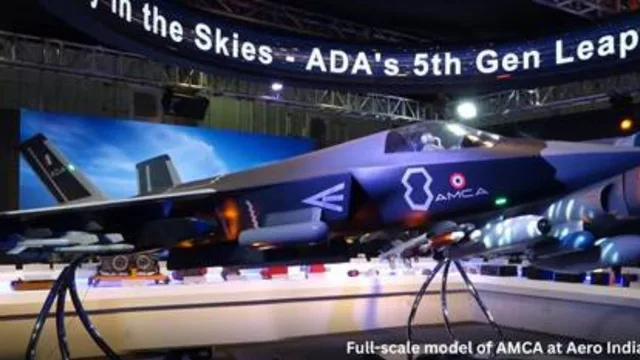
The stakes are high, as the chosen Development-cum-Production Partner (DcPP) will collaborate with the Aeronautical Development Agency (ADA) to transform the AMCA's design into a flying aircraft. The winning bidder will be responsible for building five flying prototypes and one structural test aircraft at the new facility in Puttaparthi, Andhra Pradesh. This partnership will also serve as a natural choice for series production, marking the establishment of a second national fighter-production line alongside HAL's Tejas line.
The prototype phase is fully government-funded, with an estimated budget of ₹15,000 crore. This significant investment underscores the government's commitment to developing a cutting-edge combat aircraft that meets India's military requirements.
Nanoweave Composites — Precision Engineered Carbon Fiber
Empowering aerospace, UAV defense & robotics with high-performance carbon fiber sheets, custom drone frames & precision CNC composite machining.
Explore Carbon Fiber →The Contenders
Three private-led consortia have been shortlisted for the AMCA development partner selection:
- Tata Advanced Systems (TASL): The sole independent bidder, TASL boasts a proven track record in aircraft assembly, having set up a final assembly line for the C-295 transport aircraft in collaboration with Airbus. The company also manufactures airframe components, such as wings and fuselage sections, for global original equipment manufacturers (OEMs).
- L&T – BEL – Dynamatic Technologies: This consortium brings together complex defence engineering and systems integration expertise from L&T, state-owned BEL's defence electronics capabilities, and Dynamatic Technologies' experience in aerospace structures manufacturing.
- Bharat Forge – BEML – Data Patterns: The team combines advanced manufacturing and precision engineering from Bharat Forge, large-scale military and heavy-vehicle production from BEML, and defence and aerospace electronics expertise from Data Patterns.
Strengths and Watchpoints
Each consortium has its strengths and watchpoints:
- TASL: Real aircraft-assembly experience, private-sector track record of timely delivery, and agility. However, it lacks experience in leading a complete combat-aircraft programme and embedded electronics and systems-integration partner.
- L&T – BEL – Dynamatic Technologies: The most balanced consortium, covering integration, electronics, and aerostructures. However, no member has led a full fighter programme, and the integration risk sits with L&T.
- Bharat Forge – BEML – Data Patterns: Strong on manufacturing scale and electronics, with a defence PSU partner in BEML. However, the team's centre of gravity is vehicles, forgings, and electronics rather than large airframe assembly.
HAL's Exclusion
HAL, the default production agency for India's fighters for decades, was not shortlisted for the AMCA development partner selection. The company's order book value is over eight times its FY25 turnover, which failed to meet the mandatory technical criteria. Defence Secretary R.K. Singh stated that HAL "did not qualify on some fairly routine technical grounds." However, HAL has reserved the right to bid again when fresh tenders open up for the licence manufacture of the jet.
The Selection Process
The selection process reflects a candid appraisal of India's industrial base, highlighting its limited experience in large composite aeronautical structures, insufficient autoclave capacity, and reliance on subcontractors for critical areas. The winning consortium must raise a new entity within three months of selection, with a majority of shareholders being residents of India. The first prototype of the AMCA must fly within 30 months of the contract signing, with 1,800 test flights to be completed across five prototypes within 84 months.
Key Takeaways
- The selection of the AMCA development partner is expected to conclude within four to five months of proposal submission.
- The chosen partner will collaborate with ADA to transform the AMCA's design into a flying aircraft and establish a second national fighter-production line.
- Three private-led consortia have been shortlisted for the selection: Tata Advanced Systems, L&T – BEL – Dynamatic Technologies, and Bharat Forge – BEML – Data Patterns.
- HAL was not shortlisted due to failing to meet the mandatory technical criteria, but has reserved the right to bid again in the future.
- The selection process reflects a candid appraisal of India's industrial base, highlighting areas for improvement and the need for a robust partner to fill the gaps.
Takshak CAM — Feature-Recognition CAM You Own Outright
Import STEP solids, automatically detect machinable features & post collision-checked 3-axis and 4-axis G-code. Perpetual license with zero recurring subscriptions.
Based on reporting from the original source. See our Copyright Policy for details.