Defense Bulletin
India's AMCA Programme: HAL's Disqualification and the Future of Indigenous Fighter Aircraft
ADVERTISEMENT
SPONSORED
INDIGENOUS CNC SYSTEMS
Akriti Precision Systems — High-Precision Desktop CNC Milling
Made-in-India desktop CNC machines with composite superstructures, 15–25 µm repeatability & lifetime frame warranty. Built for aerospace, carbon fiber & precision prototyping.
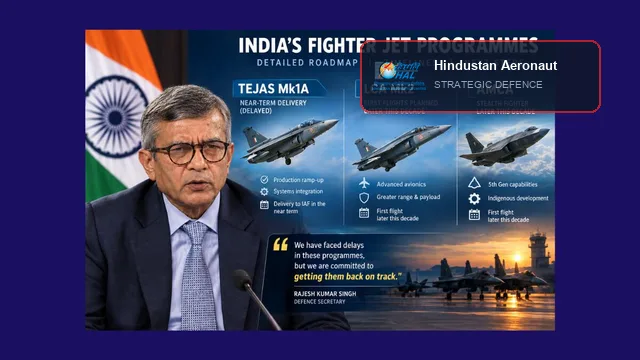
Explore CNC Systems →India's AMCA Programme: HAL's Disqualification and the Future of Indigenous Fighter Aircraft\n\nIn a significant development, Hindustan Aeronautics Limited (HAL) has been disqualified from the Advanced Medium Combat Aircraft (AMCA) prototype competition due to a technical failure. The exact criterion that led to HAL's disqualification remains unclear, but Defence Secretary RK Singh has confirmed that the failure was not due to a lack of aircraft-design capability or aerospace expertise.\n\nThe government's open-ended selection process has enabled private-sector-led teams to participate in the ₹15,000 crore prototype programme, which aims to develop five flying prototypes and one structural test aircraft. The Aeronautical Development Agency (ADA) has retained design authority over the aircraft.\n\nHAL's exclusion from the AMCA prototype competition is significant, given its commanding position in India's indigenous fighter-aircraft production ecosystem. The company has manufactured the Tejas and has extensive experience in aircraft production, licensed manufacturing, overhaul, and aerospace integration.\n\nHowever, these capabilities have failed to win HAL a place in the AMCA prototype competition. The government's stated objective is not only to find a company to build the first prototypes but also to create a second fighter production line rather than rely solely on one production line. This means that the AMCA programme will serve as a basis for creating additional industrial capacity for India's future combat-aircraft fleet.\n\nThe reason why HAL failed the technical evaluation has yet to be revealed. That makes the wording used by the Defence Secretary crucial in the way that it implies that the failed requirement was a specified qualification condition rather than a judgement that HAL was incapable of developing or manufacturing the AMCA.\n\nUntil the government or the relevant evaluation documents identify the criterion, explanations about HAL's workload, production capacity, financial position, infrastructure, or engineering capability can remain unconfirmed possibilities rather than established reasons.\n\nThe AMCA programme is a significant step towards creating a second fighter production line in India. The programme's open-ended selection process has enabled private-sector-led teams to participate in the prototype development, which is estimated to cost around ₹15,000 crore.\n\nThe development of the AMCA is a complex process that requires significant investment and expertise. The programme's success will depend on the ability of the selected teams to meet the technical and financial requirements of the project.\n\nIn conclusion, HAL's disqualification from the AMCA prototype competition is a significant development that highlights the challenges faced by India's indigenous fighter-aircraft production ecosystem. The programme's success will depend on the ability of the selected teams to meet the technical and financial requirements of the project, and create additional industrial capacity for India's future combat-aircraft fleet.
ADVERTISEMENT
SPONSORED
AEROSPACE COMPOSITES
Nanoweave Composites — Precision Engineered Carbon Fiber
Empowering aerospace, UAV defense & robotics with high-performance carbon fiber sheets, custom drone frames & precision CNC composite machining.
Explore Carbon Fiber →
ADVERTISEMENT
DEFENSE CAD/CAM SOFTWARE
Discover Takshak CAM →
Takshak CAM — Feature-Recognition CAM You Own Outright
Import STEP solids, automatically detect machinable features & post collision-checked 3-axis and 4-axis G-code. Perpetual license with zero recurring subscriptions.
Based on reporting from the original source. See our Copyright Policy for details.