Defense Bulletin
India's Akash Family: The Shield Against Low-Flying Cruise Missiles
ADVERTISEMENT
SPONSORED
INDIGENOUS CNC SYSTEMS
Akriti Precision Systems — High-Precision Desktop CNC Milling
Made-in-India desktop CNC machines with composite superstructures, 15–25 µm repeatability & lifetime frame warranty. Built for aerospace, carbon fiber & precision prototyping.
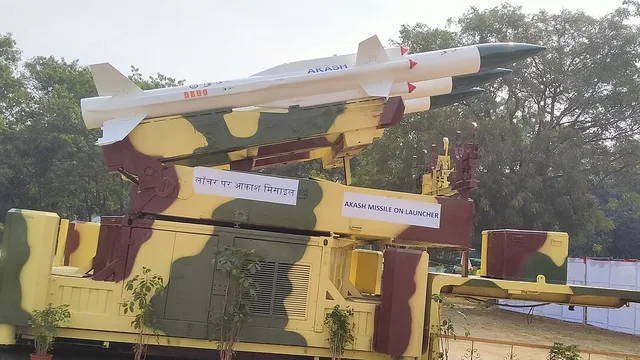
Explore CNC Systems →India's Akash Family: The Shield Against Low-Flying Cruise Missiles\n\nIn the realm of modern air defence, the threat of low-flying cruise missiles has become increasingly significant. The Fatah-4, a ground-launched cruise missile developed by Pakistan, is a prime example of this threat. With its 750 km range and 50 m minimum flight altitude, the Fatah-4 evades radar detection by flying low and terrain-hugging.\n\nHowever, India's Akash family of missiles has been designed to counter this threat. The Akash is a medium-range surface-to-air missile system developed by the Defence Research and Development Organisation (DRDO) and built by Bharat Dynamics and Bharat Electronics. It is in service with the Indian Army and Air Force, and its stated role has always included cruise missiles alongside aircraft, helicopters, and drones.\n\nThe Akash's fire-control sensor, the Rajendra, is a mobile passive phased-array radar that tracks up to 64 targets, guides multiple missiles, and is explicitly described as being capable of engaging low-RCS targets. In a group deployment, a 3D Central Acquisition Radar provides the wide early-warning picture, tracking hundreds of targets and handing tracks to the battery.\n\nOnce a track is handed over, the geometry favours the interceptor. The Akash leaves the rail at Mach 2.5 to 3.5, three to four times faster than the Fatah-4's cruise speed of about Mach 0.7. This speed margin, combined with an all-the-way-powered flight and high manoeuvrability, gives the missile an expansive no-escape zone: the target cannot simply outrun or out-turn it.\n\nThe 60 kg pre-fragmented warhead and proximity fuze are designed to shred a thin-skinned cruise missile on a near-miss rather than requiring a direct hit. The engagement is orchestrated by India's air-defence networks – the IAF's Integrated Air Command and Control System (IACCS) and the Army's Akashteer – which fuse radar and sensor data into a single air picture, rank threats, and assign weapons.\n\nIn the Indian grid, the Akash family sits in the medium-range tier, between point-defence systems and the long-range S-400. The Akash family's low-altitude cruise-missile pedigree is not theoretical. In June 2014, an Akash was fired in a 'very low altitude near boundary mission' and intercepted a small, fast-moving Banshee aerial vehicle at 30 m above sea level.\n\nThe Rajendra radar's guidance performance has been demonstrated at engagements as close as 15 m. The most important evidence is operational. During Operation Sindoor in May 2025, Pakistan launched waves of drones, loitering munitions, and missiles, including Fatah-2 guided rockets, against Indian targets. India's layered grid, with the Akash as a key medium-range layer, intercepted the great majority, and the Akash drew particular credit from the government and Air Force for its performance.\n\nIn conclusion, the Akash family of missiles is a formidable air defence system designed to counter the threat of low-flying cruise missiles like the Fatah-4. With its advanced radar systems, speed margin, and manoeuvrability, the Akash is well-equipped to take on the Fatah-4 threat and provide a critical layer of air defence for India.
ADVERTISEMENT
SPONSORED
AEROSPACE COMPOSITES
Nanoweave Composites — Precision Engineered Carbon Fiber
Empowering aerospace, UAV defense & robotics with high-performance carbon fiber sheets, custom drone frames & precision CNC composite machining.
Explore Carbon Fiber →
ADVERTISEMENT
DEFENSE CAD/CAM SOFTWARE
Discover Takshak CAM →
Takshak CAM — Feature-Recognition CAM You Own Outright
Import STEP solids, automatically detect machinable features & post collision-checked 3-axis and 4-axis G-code. Perpetual license with zero recurring subscriptions.
Based on reporting from the original source. See our Copyright Policy for details.