India's Air Force Rebuild: A Decade of Challenges Ahead
The Indian Air Force's authorised strength of 42 squadrons has been a distant dream for over a decade. With the current strength at 29, equivalent to 520-530 combat aircraft, India must add 13 squadrons to reach the target. However, the actual requirement is larger due to retiring aircraft.
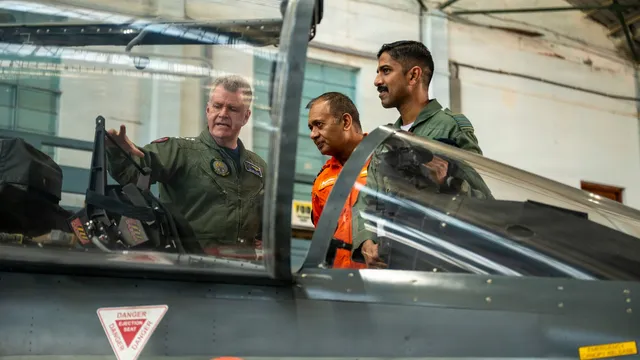
The foundation of the rebuilding effort lies in the Tejas programme. With 180 Tejas Mk1A aircraft expected to become the backbone of future fighter strength, the programme has the potential to significantly contribute to the IAF's rebuilding effort. The Tejas Mk1A aircraft is currently in production, with Hindustan Aeronautics Limited (HAL) working towards increasing production capacity to approximately 24 aircraft annually.
Another significant contributor to the IAF's rebuilding effort is the proposed Multi-Role Fighter Aircraft programme. With deliveries of 114 Rafale fighters beginning around 2029, the programme has the potential to substantially strengthen the IAF's high-end combat capability. The Rafale fighter is a highly advanced aircraft, equipped with cutting-edge technology and capabilities that make it a formidable opponent in the skies.
However, the challenge is not just adding 13 squadrons, but replacing 12 retiring squadrons while creating 13 additional ones. This requires a complex and challenging process that involves sustained production rates, stable engine supplies, and timely procurement decisions. The IAF's rebuilding effort will be a long-term process that will require significant investments in infrastructure, training, and equipment.
The Tejas Mk2 is expected to become the medium-weight backbone of the force during the following decade. The aircraft is currently progressing through development, with production anticipated to begin around the start of the next decade. If India orders approximately 120 aircraft and production reaches between 16 and 20 aircraft annually, deliveries could extend until around 2037.
Beyond these confirmed indigenous programmes lies a more speculative component. Some defence analysts have suggested that India could temporarily strengthen its heavy fighter capability through the acquisition of approximately 60 Su-57 stealth fighters if such a proposal were accepted. However, it is essential to note that India has neither announced nor approved any procurement of the Su-57. The aircraft is frequently discussed in strategic analyses because Russia has publicly offered technology transfer and local production, but it remains only one of several possible future options rather than an approved programme.
Assuming these parallel induction programmes progress broadly according to current expectations, the IAF's squadron strength could evolve in distinct phases. Between 2026 and 2030, the retirement of the first Jaguar squadrons would likely be partially offset by Tejas Mk1A inductions, stabilising fighter strength around 30-31 squadrons rather than allowing further decline.
The most significant growth would occur between 2031 and 2035, when Tejas Mk1A production reaches maturity, Rafale deliveries accelerate, and Tejas Mk2 enters serial production. This period could see the fighter fleet expand toward approximately 37 squadrons despite continued retirements.
By 2035 and 2036, as the remaining Mirage 2000 and MiG-29 squadrons leave service, continued Rafale and Tejas Mk2 inductions could push the IAF close to 41 squadrons. Completion of the Tejas Mk2 production run around 2037 would then allow the Air Force to reach or marginally exceed its sanctioned strength of 42 squadrons, assuming procurement schedules remain largely on track and no major delays occur.
Several uncertainties, however, could affect this timeline. Production rates must be sustained without interruption, engine supplies for Tejas Mk1A and Mk2 must remain stable, infrastructure must expand to accommodate multiple assembly lines, and procurement decisions—particularly regarding MRFA—must be taken without prolonged delays.
Moreover, future force planning will increasingly depend on the development of the Advanced Medium Combat Aircraft (AMCA), which is expected to begin replacing older fourth-generation fighters during the latter half of the 2030s. The AMCA programme has the potential to significantly contribute to the IAF's rebuilding effort, but it will require significant investments in research and development, infrastructure, and training.
In conclusion, the Indian Air Force's rebuilding effort will be a complex and challenging process that requires sustained production rates, stable engine supplies, and timely procurement decisions. With the Tejas programme and the proposed Multi-Role Fighter Aircraft programme expected to significantly contribute to the IAF's rebuilding effort, the Air Force is likely to reach its sanctioned strength of 42 squadrons by 2036-37, assuming procurement schedules remain largely on track and no major delays occur.
Based on reporting from the original source. See our Copyright Policy for details.