Indian UAV Sector Takes Flight as Local Engine Makers Make Waves
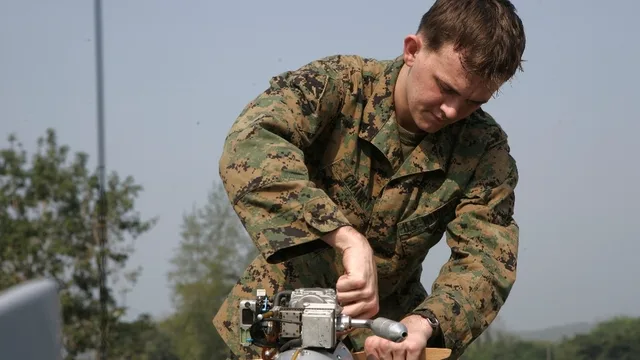
The Indian UAV sector has been making significant strides in recent years, with local companies like Raphe mPhibr taking center stage in the development of advanced propulsion systems. The company's recent unveiling of a 250 kW piston engine has sent shockwaves through the industry, with many experts hailing it as a game-changer for heavy unmanned aerial vehicles.
This powerful engine, equivalent to 335 horsepower, outpaces the requirements of many 1.5-ton class UAVs, providing greater payload margins and improved performance. The additional power could prove particularly beneficial for UAVs carrying advanced sensors and equipment, such as electro-optical sensors, electronic warfare equipment, communications systems, or radar payloads.
However, piston-engine propulsion also presents its own set of challenges. Two-stroke piston engines can generate significant vibration, requiring carefully engineered engine mounts, isolation systems, and structural damping. This becomes particularly important on intelligence, surveillance, and reconnaissance UAVs carrying high-end electro-optical sensors, stabilized turrets, communications equipment, or airborne radar.
The Indian requirement for 87 Medium Altitude Long Endurance (MALE) UAVs is expected to drive demand for UAVs capable of sustained surveillance and reconnaissance missions while carrying substantial mission payloads. If Raphe mPhibr can successfully integrate its propulsion technology with a suitable MALE UAV design, the company could position itself as a significant Indian contender in the growing military UAV sector.
The company's emergence with a 250 kW-class engine represents more than simply an increase in propulsion power. It forms part of the broader effort to build a domestic propulsion ecosystem for larger UAVs, reducing dependence on imported engines while allowing greater integration between the airframe, propulsion system, and mission equipment.
Raphe mPhibr's participation in the Indian tri-service 87 MALE UAV competition adds further significance to the development. The company's ability to successfully integrate its propulsion technology with a suitable MALE UAV design could be a major turning point in the growth of India's military UAV sector.
The stakes are high, but Raphe mPhibr's engine could be the key to unlocking India's next-gen UAV capabilities. With its participation in the Indian tri-service 87 MALE UAV tender, the company is poised to make a significant impact in the sector. The future of Indian UAVs has never looked more exciting, with the potential for increased payload capacity, improved performance, and reduced dependence on imported engines.
Building a Domestic Propulsion Ecosystem
Raphe mPhibr's emergence with a 250 kW-class engine represents a significant step towards building a domestic propulsion ecosystem for larger UAVs. By reducing dependence on imported engines, the company can focus on integrating its propulsion technology with airframes and mission equipment, creating a more cohesive and efficient system.
The Importance of Integration
The integration of propulsion technology with airframes and mission equipment is crucial for the success of Indian UAVs. By working closely with the Indian armed forces and other stakeholders, Raphe mPhibr can ensure that its propulsion technology is optimized for the specific requirements of the Indian military.
The Indian Tri-Service 87 MALE UAV Tender
The Indian requirement for 87 MALE UAVs is a significant opportunity for local companies like Raphe mPhibr to showcase their capabilities. The tender is expected to drive demand for UAVs capable of sustained surveillance and reconnaissance missions while carrying substantial mission payloads.
Key Takeaways
- Raphe mPhibr's 250 kW piston engine is a game-changer for heavy unmanned aerial vehicles, providing greater payload margins and improved performance.
- The engine's power output is well above the typical requirements of 1.5-ton class UAVs, which usually need around 60-110 kW (80-150 horsepower) for operations.
- Piston-engine propulsion presents engineering challenges, requiring careful engine mounts, isolation systems, and structural damping to minimize vibration.
- Raphe mPhibr's participation in the Indian tri-service 87 MALE UAV tender adds further significance to the development, positioning the company as a major player in India's growing military UAV sector.
- The future of Indian UAVs has never looked more exciting, with the potential for increased payload capacity, improved performance, and reduced dependence on imported engines.
Based on reporting from the original source. See our Copyright Policy for details.