Indian Navy Unveils Ambitious Plan to Fortify Warship Fleet with Indigenous Air Defence Missiles
India Defence & Aerospace Indigenisation Summit 2026
Accelerating private defense manufacturing, UAV innovation, and strategic aerospace corridors.
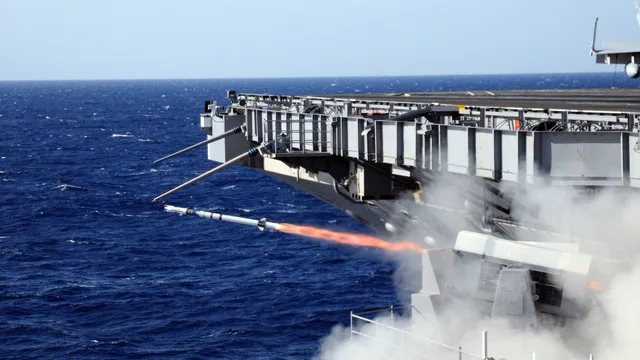
Explore Strategic Intel →The Indian Navy has taken a significant step forward in bolstering its air-defence capabilities with the unveiling of a two-tier deployment plan for its indigenous Project Kusha Naval Air Defence Missiles. This strategic move marks a significant enhancement to the Navy's air-defence posture, providing a flexible and adaptable response to emerging threats.
The Navy plans to deploy different versions of the Project Kusha Extended Range Air Defence System (ERADS) across its warship fleet, adopting a tailored approach rather than a one-size-fits-all strategy. This approach leverages a scalable air-defence architecture, where the two different missile variants share common technologies, including a common guidance package and kill vehicle.
The Kusha M1 short-range interceptor, capable of engaging targets at ranges of approximately 150 km, will be fitted on smaller surface combatants, including future corvettes, the Next Generation Missile Vessels (NGMV), and certain frigates. These vessels are limited by the depth of their Vertical Launch System (VLS) cells, displacement capacity, and weight-carrying capacity, making the smaller, lighter M1 variant a more practical solution.
India Defence & Aerospace Indigenisation Summit 2026
Accelerating private defense manufacturing, UAV innovation, and strategic aerospace corridors.
Explore Strategic Intel →In contrast, the longer-range Kusha M2, with a range of around 250 km, will be reserved for the Navy's largest destroyers and future aircraft carriers. This variant will provide extended defensive coverage, allowing high-value units to engage hostile aircraft, anti-ship cruise missiles, and airborne early warning (AEW) aircraft well before they can threaten the carrier group.
The Kusha missile family's common design allows the Navy to fit multiple variants of the same missile on its ships without developing separate missile systems, reducing complexity and enhancing overall effectiveness. The Kusha M1 variant will utilise a smaller and lighter booster, while retaining the same terminal guidance and hit-to-kill technologies shared across the Kusha family.
This design enables smaller combatants to possess a robust area air defence capability without requiring larger VLS cells or imposing excessive weight, which would compromise their stability and performance. The Indian Navy's two-tier deployment plan for Project Kusha Naval Air Defence Missiles represents a significant enhancement to its air-defence capabilities, providing a flexible and adaptable response to emerging threats.
By leveraging a scalable architecture and common technologies, the Navy can optimise its missile performance, streamline logistics and maintenance, and enhance crew training, ultimately bolstering its overall defence posture. The Navy's approach is similar to the layered naval air-defence concepts utilised by several of its maritime counterparts, where different ranges are allocated to different classes of warships depending on their roles and size, utilising common systems wherever possible.
Project Kusha is the product of the Defence Research and Development Organisation (DRDO) and is India's indigenous long-range air-defence system, designed to take on a variety of threats. Multiple variants of the M1 and M2 interceptors are proposed to take on fighter aircraft, as well as cruise missiles, UAVs, and a selection of ballistic missile threats, offering similar capabilities to long-range surface-to-air missiles.
The Indian Navy's two-tier deployment plan for Project Kusha Naval Air Defence Missiles marks a significant milestone in the country's efforts to enhance its air-defence capabilities. With this ambitious plan, the Navy is poised to provide a robust and adaptable response to emerging threats, ensuring the security of its warship fleet and the nation's maritime interests.
Key Takeaways
- The Indian Navy has unveiled a two-tier deployment plan for its indigenous Project Kusha Naval Air Defence Missiles, set to bolster its air-defence capabilities across its warship fleet.
- The Navy plans to deploy different versions of the Project Kusha Extended Range Air Defence System (ERADS) across its warship fleet, adopting a tailored approach rather than a one-size-fits-all strategy.
- The Kusha M1 short-range interceptor will be fitted on smaller surface combatants, while the longer-range Kusha M2 will be reserved for the Navy's largest destroyers and future aircraft carriers.
- The Kusha missile family's common design allows the Navy to fit multiple variants of the same missile on its ships without developing separate missile systems, reducing complexity and enhancing overall effectiveness.
- The Indian Navy's two-tier deployment plan for Project Kusha Naval Air Defence Missiles represents a significant enhancement to its air-defence capabilities, providing a flexible and adaptable response to emerging threats.
India Defence & Aerospace Indigenisation Summit 2026
Accelerating private defense manufacturing, UAV innovation, and strategic aerospace corridors.
Based on reporting from the original source. See our Copyright Policy for details.