India Air Force Chief's J-35 Assessment Exposed as Warning on Own Stealth Fighter Shortfall
Akriti Precision Systems — High-Precision Desktop CNC Milling
Made-in-India desktop CNC machines with composite superstructures, 15–25 µm repeatability & lifetime frame warranty. Built for aerospace, carbon fiber & precision prototyping.
Explore CNC Systems →Indian Air Force Day: A Window into the Indo-Pak Rivalry
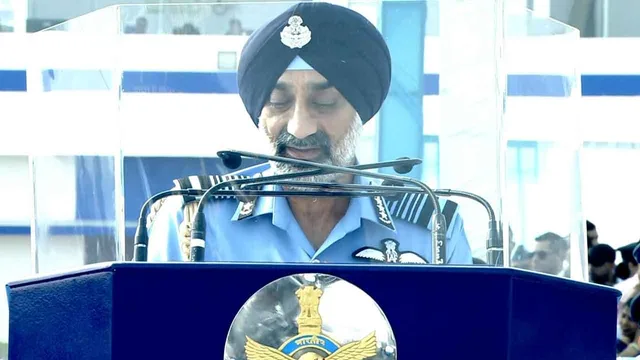
As India celebrated its Air Force Day on October 8, 2026, Chinese media outlets seized the opportunity to scrutinize the statements of Indian Air Chief Marshal A.P. Singh, sparking a debate on the country's stealth fighter capabilities. Singh's comments on Pakistan's plans to acquire China's J-35 stealth fighter plane have been interpreted as a veiled warning to New Delhi about its own fifth-generation fighter deficit.
The J-35 Conundrum
The Indian Air Force's assessment of Pakistan's intentions to induct the J-35 has been a subject of interest for Chinese commentators. Singh acknowledged that Pakistan is planning to integrate the J-35 into its combat aircraft fleet, including reports that Pakistan Air Force pilots have been training in China. However, he downplayed the significance of this development, stating that the induction of one advanced aircraft would not determine the outcome of a conflict.
India's Stealth Fighter Dilemma
In contrast, Singh's remarks on India's own stealth fighter capabilities have been seen as a reflection of the country's concerns about its fifth-generation fighter deficit. The Advanced Medium Combat Aircraft (AMCA) project, currently projected to enter service between 2030 and 2035, has been plagued by delays and technical issues. This has led some to suggest that India may need to explore alternative options, including the acquisition of foreign stealth fighters like the Su-57E.
Nanoweave Composites — Precision Engineered Carbon Fiber
Empowering aerospace, UAV defense & robotics with high-performance carbon fiber sheets, custom drone frames & precision CNC composite machining.
Explore Carbon Fiber →A Battle for Supremacy
The J-35 is not the only factor in the Indo-Pak rivalry. Both countries have been engaged in a cat-and-mouse game, with each side trying to outdo the other in terms of military capabilities. The Pakistan Air Force's J-10CE fighters, PL-15E air-to-air missiles, and ZDK-03 airborne early warning and control (AEW&C) aircraft have been integrated into a seamless Chinese combat network. In contrast, India's combat aircraft fleet is more diverse, incorporating Russian, French, Israeli, and indigenous aircraft, as well as varying mission systems, communication protocols, and weapons.
Hypersonic Weapons: A Game-Changer?
The development of hypersonic weapons has the potential to tip the balance in favor of the side that possesses them. Both India and Pakistan have been pursuing the development of hypersonic weapons, but neither appears to have deployed them in their active inventory. The deployment of hypersonic cruise missiles could provide a significant advantage in a peer-versus-peer conflict due to their speed and difficulty to intercept.
The AMCA Project: A Long Road Ahead
India's AMCA project aims to produce a fifth-generation jet, but it still has a long way to go before an airframe is ready for production. The project is projected to enter service by the early 2030s, well after experts predict the J-35 could enter service. Acquiring a foreign stealth fighter could enable India to fill fifth-generation fighter requirements more quickly, but its military, economy, and national security considerations will determine whether such an acquisition takes place.
Key Takeaways
- Indian Air Chief Marshal A.P. Singh's comments on Pakistan's plans to acquire China's J-35 stealth fighter plane have been interpreted as a veiled warning to New Delhi about its own fifth-generation fighter deficit.
- The Indian Air Force's assessment of Pakistan's intentions to induct the J-35 has been a subject of interest for Chinese commentators, who see it as a reflection of India's concerns about its stealth fighter capabilities.
- India's combat aircraft fleet is more diverse than Pakistan's, incorporating Russian, French, Israeli, and indigenous aircraft, as well as varying mission systems, communication protocols, and weapons.
- Both India and Pakistan have been pursuing the development of hypersonic weapons, but neither appears to have deployed them in their active inventory.
- India's AMCA project aims to produce a fifth-generation jet, but it still has a long way to go before an airframe is ready for production.
Takshak CAM — Feature-Recognition CAM You Own Outright
Import STEP solids, automatically detect machinable features & post collision-checked 3-axis and 4-axis G-code. Perpetual license with zero recurring subscriptions.
Based on reporting from the original source. See our Copyright Policy for details.