Carrier-Ready Drones: Indian Navy's Ambitious UAV Plan Takes Shape
India Defence & Aerospace Indigenisation Summit 2026
Accelerating private defense manufacturing, UAV innovation, and strategic aerospace corridors.
Explore Strategic Intel →Indian Navy's Ambitious UAV Plan Takes Shape
The Indian Navy is making significant strides in its unmanned aerial vehicle (UAV) program, with a focus on developing Medium-Altitude Long-Endurance (MALE) and High-Altitude Long-Endurance (HALE) drones for aircraft carrier operations. This ambitious plan, which could take 5-10 years to materialize, aims to integrate UAVs into the Navy's fleet, enhancing its surveillance and reconnaissance capabilities.
Modified UAVs for Carrier Ops
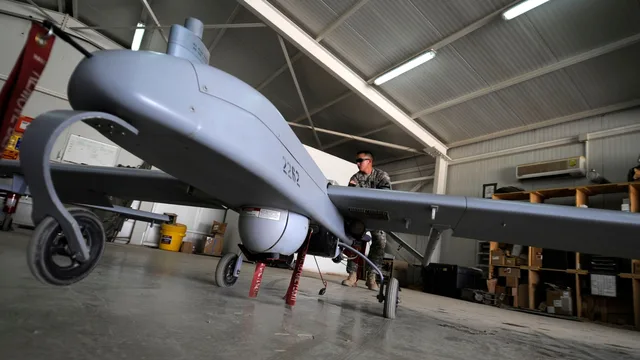
To operate from aircraft carriers, MALE UAVs require reinforced landing gear and folding wings, designed to withstand the high-impact stresses of carrier traps. The Indian Navy is keen to develop these capabilities, drawing inspiration from other countries that have successfully modified their UAVs for carrier operations. The Navy's engineers are working tirelessly to adapt these designs to suit their specific needs, ensuring seamless integration with their existing fleet.
Focus on Rotary-Wing VTOL Systems
While the Navy's immediate focus is on rotary-wing and tilt-rotor Vertical Takeoff and Landing (VTOL) systems, they are also exploring the potential of MALE and HALE UAVs. These systems do not require major changes to the carrier deck or special control rooms, making them an attractive option for the Navy. However, the long-term plan is to integrate these UAVs into the fleet, which will necessitate significant modifications to the IAC-II design.
India Defence & Aerospace Indigenisation Summit 2026
Accelerating private defense manufacturing, UAV innovation, and strategic aerospace corridors.
Explore Strategic Intel →IAC-II Design Modifications
The Indian Navy is already considering major changes to the IAC-II design, which will be based on the Vikrant design but with significant improvements. These modifications will enable the IAC-II to house and operate MALE and HALE UAVs, including SATCOMs terminals and control rooms. This ambitious plan will require significant investment and resources, but the Navy is confident that it will pay off in the long run.
Procurement and Development
The Indian Navy plans to procure MALE UAVs as part of a tender for 87 units, which has been issued in collaboration with the Air Force and Army. The winning OEM will be tasked with developing the UAVs for deck-based operations, which will be a significant milestone in the Navy's UAV program. The first focus will be on the MALE platform, which can be converted to operate from an aircraft carrier.
Key Takeaways
- The Indian Navy is developing MALE and HALE UAVs for aircraft carrier operations, a 5-10 year plan.
- MALE UAVs require reinforced landing gear and folding wings for carrier ops.
- The Navy is focusing on rotary-wing VTOL systems, but also exploring MALE and HALE UAVs.
- IAC-II design modifications will enable the integration of UAVs, SATCOMs, and control rooms.
- The Navy plans to procure MALE UAVs as part of a tender for 87 units, with a focus on deck-based operations.
India Defence & Aerospace Indigenisation Summit 2026
Accelerating private defense manufacturing, UAV innovation, and strategic aerospace corridors.
Based on reporting from the original source. See our Copyright Policy for details.