Beyond Borders: India's Agni-IV Missile Sets the Stage for Global Strategic Reckoning
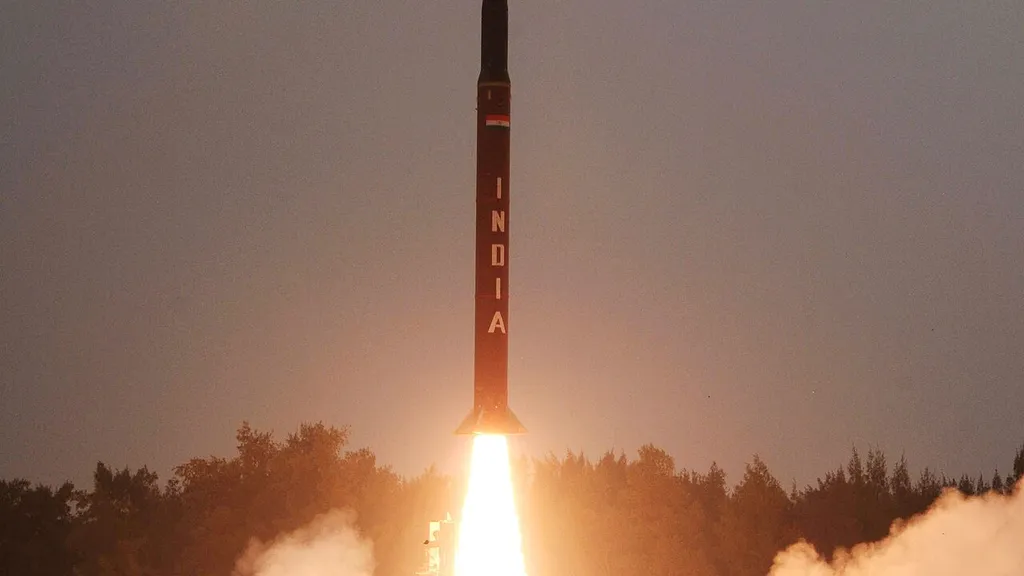
India's Agni-IV missile has sent shockwaves across the defence community, particularly in Turkey, where the news has sparked heated discussions among defence commentators. The revelation stems from a range map shared by open-source intelligence analyst Damien Symon on X, which revealed the missile's extensive reach across Eurasia.
The map, which quickly went viral on Turkish social media, showed that the Agni-IV's approximately 4,000-kilometre strike envelope extends far beyond India's immediate neighbourhood, covering large parts of Central Asia, western China, Russia, the Middle East, and even Turkey. The reactions from Turkish commentators highlighted the relatively underappreciated nature of India's strategic missile capabilities outside Asia.
India's successful test of the Agni-IV intermediate-range ballistic missile was conducted from Dr APJ Abdul Kalam Island off the Odisha coast on August 6. The launch was carried out by the Strategic Forces Command as part of routine operational validation, confirming the missile's readiness and reliability within India's nuclear deterrence architecture. Defence officials described the test as successful, with all mission objectives being achieved.
The Agni-IV, often overshadowed by the longer-range Agni-V, remains a vital component of India's strategic forces. With a strike range of around 4,000 kilometres, it occupies the capability gap between the Agni-III and Agni-V, providing Indian planners with flexible options against targets across Asia and beyond. Equipped with advanced navigation systems, composite rocket motors, and a ring laser gyro-based inertial navigation system supported by micro-navigation technologies, the missile is capable of delivering high levels of accuracy over long distances.
The Turkish reactions largely stemmed from the visual representation of the missile's reach rather than any indication that Turkey is a target in Indian strategic planning. India's nuclear doctrine remains based on credible minimum deterrence and a declared No First Use policy. The country's ballistic missile force is structured primarily to ensure strategic deterrence against nuclear-armed adversaries and not for conventional power projection against distant nations.
The discussion also reflects the growing influence of open-source intelligence on global defence conversations. Maps and technical analyses shared by independent analysts such as Damien Symon frequently generate international attention by presenting complex military capabilities in easily understandable visual formats. In this instance, the range ring provided a clear illustration of India's strategic reach, prompting observers from countries not traditionally associated with South Asian security debates to take notice.
India's strategic missile programme has evolved significantly since the induction of the first Agni variants. While Agni-IV provides robust regional deterrence, the induction of Agni-V has extended India's reach to well over 5,000 kilometres, allowing coverage of virtually all potential strategic targets relevant to India's security calculations. Reports also indicate continued work on advanced technologies, including Multiple Independently Targetable Re-entry Vehicle (MIRV) capability and improvements in survivability and response time.
The surprise expressed by some Turkish commentators ultimately illustrates how India's strategic capabilities are increasingly being recognised well beyond the Indo-Pacific region. As India's indigenous missile programme continues to mature through regular user trials and technological upgrades, its strategic deterrence posture is drawing wider international attention, reinforcing the country's position as one of the world's leading missile powers.
India's strategic missile programme is a testament to the country's growing capabilities in the realm of defence. With a focus on indigenous development and technological advancements, India is well on its way to becoming a major player in the global defence landscape. As the Agni-IV missile continues to make headlines, it is clear that India's strategic capabilities are no longer a secret, and the world is taking notice.
Based on reporting from the original source. See our Copyright Policy for details.