Defense Bulletin
Armenia Embarks on Pinaka Mk-II Domestic Manufacturing Journey
ADVERTISEMENT
SPONSORED
INDIGENOUS CNC SYSTEMS
Akriti Precision Systems — High-Precision Desktop CNC Milling
Made-in-India desktop CNC machines with composite superstructures, 15–25 µm repeatability & lifetime frame warranty. Built for aerospace, carbon fiber & precision prototyping.
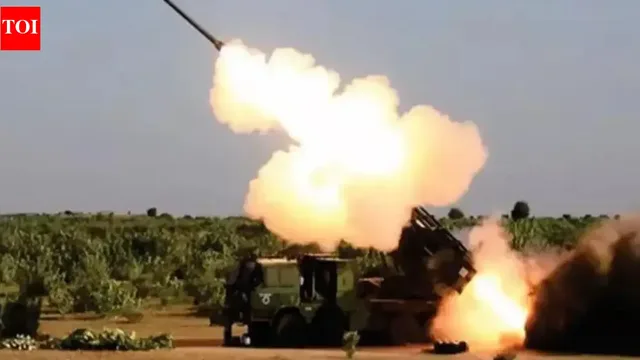
Explore CNC Systems →Armenia Embarks on Pinaka Mk-II Domestic Manufacturing Journey\n\nIn a significant development, Armenia and India are engaged in talks to establish local production and assembly of Pinaka Mk-II rockets in Armenia. This potential collaboration could have far-reaching implications for India's defence-industrial ties with Armenia and help Yerevan in sourcing a more stable supply of ammunition for its growing artillery capability.\n\nArmenia has already inducted Indian-made Pinaka Mk-II guided rockets and Pinaka Extended Range (ER) unguided rockets into its military inventory. However, the push for local production is driven by the nature of modern rocket artillery warfare, which demands a reliable and sustainable supply of ammunition.\n\nSystems like Pinaka can consume large quantities of ammunition during sustained combat operations, making local production essential for ensuring stocks and reducing dependence on repeated imports.\n\nUnder a potential arrangement, an Indian defence public-sector undertaking or other Indian defence-industry entity could provide technology support, manufacturing know-how, production assistance, and training to Armenian personnel. This would enable Armenia to gradually develop an indigenous industrial capability to surround the Pinaka system, rather than relying solely on finished rockets supplied from India.\n\nThe manufacturing model could be implemented in stages, with Armenia initially relying on Indian-origin components and materials before gradually increasing domestic content. However, complete sourcing of every component from Armenian suppliers is unlikely to come about immediately, particularly for the more technologically demanding guided variant.\n\nThe division of duties between Indian and Armenian production would depend on technical viability, export approvals, and the final industrial agreement.\n\nThe potential arrangement would also give India an opportunity to take its Pinaka ecosystem beyond exports of complete weapon systems. Local production could help Armenia's ability to maintain its ammunition reserves and potentially reduce its reliance on logistics during prolonged operations.\n\nFor India, deeper industrial cooperation with Armenia would demonstrate the expanding export potential of its indigenous rocket-artillery technology. The Pinaka family has increasingly become a major component of India's precision and massed-fire artillery strategy, offering different operational capabilities.\n\nThe discussions are at a stage where the final production model, rocket variant, and technology transfer arrangements have not yet been decided. No final agreement has been announced, and the extent of Armenian manufacturing would depend on negotiations between the two sides.\n\nIf the proposal progresses, however, Armenia could become an important overseas production partner for the Pinaka family, while India would also gain another example of defence exports evolving from supplying complete systems towards technology-assisted local manufacturing and long-term industrial partnerships.
ADVERTISEMENT
SPONSORED
AEROSPACE COMPOSITES
Nanoweave Composites — Precision Engineered Carbon Fiber
Empowering aerospace, UAV defense & robotics with high-performance carbon fiber sheets, custom drone frames & precision CNC composite machining.
Explore Carbon Fiber →
ADVERTISEMENT
DEFENSE CAD/CAM SOFTWARE
Discover Takshak CAM →
Takshak CAM — Feature-Recognition CAM You Own Outright
Import STEP solids, automatically detect machinable features & post collision-checked 3-axis and 4-axis G-code. Perpetual license with zero recurring subscriptions.
Based on reporting from the original source. See our Copyright Policy for details.