Amphibious Operations Get a Boost: India's LCU Mk V Procurement
Akriti Precision Systems — High-Precision Desktop CNC Milling
Made-in-India desktop CNC machines with composite superstructures, 15–25 µm repeatability & lifetime frame warranty. Built for aerospace, carbon fiber & precision prototyping.
Explore CNC Systems →Indian Navy's LCU Mk V Procurement: Enhancing Amphibious Operations
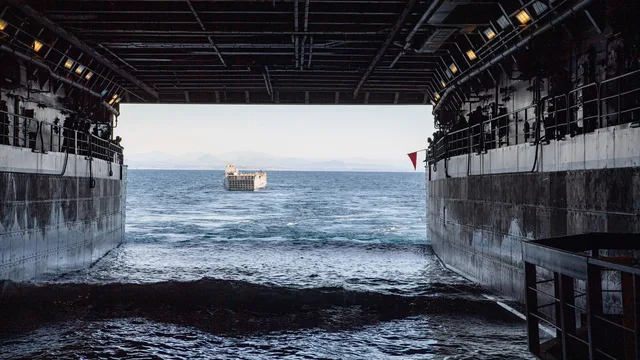
The Indian Navy has issued a Request for Information (RFI) for six Landing Craft Utility (LCU) Mk V ships, marking a significant step towards enhancing its amphibious operations. The RFI specifies a displacement of approximately 1,500 tonnes and a speed of at least 15 knots when fully loaded.
The LCU Mk V is designed to carry a range of military vehicles, including Main Battle Tanks (MBTs) and infantry fighting vehicles. The procurement of these ships will enable the Indian Navy to generate additional lift capabilities, allowing it to project power and conduct amphibious operations more effectively.
The RFI emphasizes the importance of payload capacity, with the LCU Mk V required to carry either four MBTs and four BMPs or ten Type B vehicles. This highlights the Navy's focus on maximizing its payload capacity, enabling it to transport heavier equipment and conduct more complex operations.
Nanoweave Composites — Precision Engineered Carbon Fiber
Empowering aerospace, UAV defense & robotics with high-performance carbon fiber sheets, custom drone frames & precision CNC composite machining.
Explore Carbon Fiber →The LCU Mk V is expected to measure around 85 meters in length, with a displacement of approximately 1,500 tonnes. Its speed of 15 knots is impressive, particularly when operating at 40 degrees Celsius ambient temperature and at Sea State 3. The ship will be powered by a diesel engine, providing the necessary flexibility and reliability for its projected operational profile.
A landing craft utility plays a critical role in maritime operations, providing a transport bridge between naval flagship and the shore. The LCU Mk V's ability to carry armored vehicles allows for greater flexibility in landing heavier equipment, such as tanks and infantry fighting vehicles, without relying on traditional ports and harbors.
For India, this has significant strategic implications, particularly in terms of amphibious operations and the projection of power elsewhere. The current RFI is simply an information-gathering exercise, aimed at identifying potential bidders among domestic shipbuilders. The Indian Navy will formulate its final requirements based on the responses and then proceed to procure the vessels.
The procurement of the LCU Mk V ships is a significant development for the Indian Navy, marking a major step towards enhancing its amphibious capabilities. As the Navy continues to modernize and expand its fleet, the LCU Mk V will play a critical role in supporting its operations and projecting power across the region.
Technical Specifications
- Displacement: approximately 1,500 tonnes
- Length: around 85 meters
- Speed: at least 15 knots
- Payload capacity: four MBTs and four BMPs or ten Type B vehicles
- Power source: diesel engine
Strategic Analysis
The procurement of the LCU Mk V ships is a strategic move by the Indian Navy to enhance its amphibious capabilities. The ships will enable the Navy to project power and conduct complex operations, including the transportation of heavier equipment. The RFI's emphasis on payload capacity highlights the Navy's focus on maximizing its capabilities, enabling it to respond effectively to emerging challenges in the region.
Conclusion
The Indian Navy's LCU Mk V procurement is a significant development, marking a major step towards enhancing its amphibious capabilities. The ships will play a critical role in supporting the Navy's operations and projecting power across the region. As the Navy continues to modernize and expand its fleet, the LCU Mk V will be an essential component, enabling it to respond effectively to emerging challenges and maintain its position as a major naval power.
Takshak CAM — Feature-Recognition CAM You Own Outright
Import STEP solids, automatically detect machinable features & post collision-checked 3-axis and 4-axis G-code. Perpetual license with zero recurring subscriptions.
Based on reporting from the original source. See our Copyright Policy for details.