Pakistan's Low-Altitude Flyby: A Show of Force or a Clever Ruse?
Pakistan's Low-Altitude Flyby: A Show of Force or a Clever Ruse?
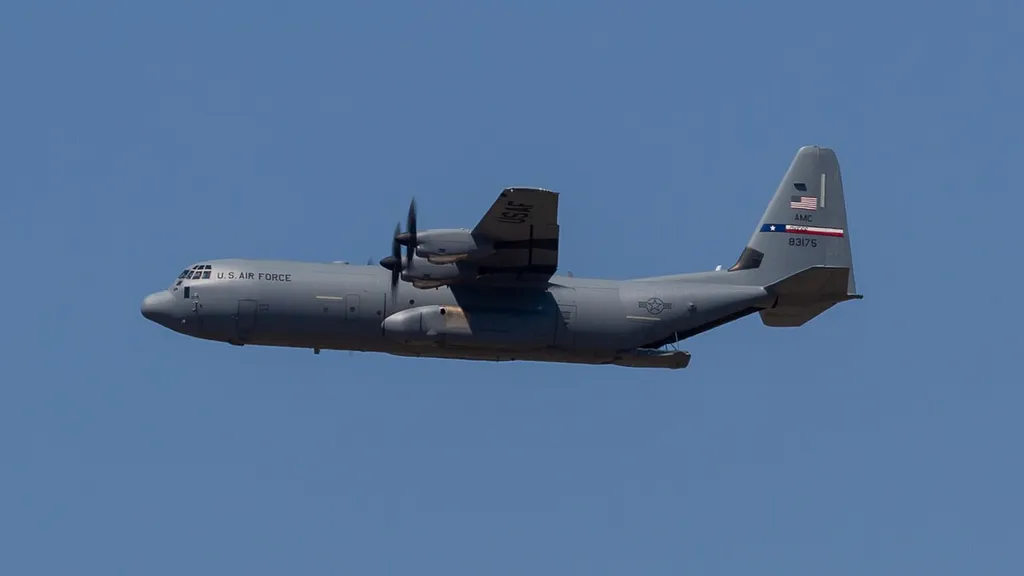
The recent emergence of fresh footage from Pakistani social media accounts has reignited debate surrounding a Pakistan Air Force C-130H Hercules seen flying at extremely low altitude while dispensing flares near Gajiana Nau, a village in Shikhupura tehsil roughly between Gujranwala and Faisalabad. The location, approximately 70 kilometres from the India-Pakistan border, is a strategic hotspot in the region.
The original clips, which first surfaced around May 9, 2025, showed the transport aircraft popping flares in dramatic bursts while hugging the ground, a manoeuvre transport crews reserve for genuine threat scenarios rather than routine flying. This behaviour is not standard training for a slow, non-manoeuvrable heavy transport like the C-130H. For such an aircraft, deploying flares while flying low and hugging terrain is typically a last-resort combination, used when a crew is either evading detection through ground clutter or has already been illuminated by a hostile radar and is trying to defeat an inbound missile.
The new multi-angle clips reinforce the original assessment that the aircraft was engaged in a real defensive response rather than a display run, since multiple independent camera positions capturing the same low pass rules out the possibility of an isolated or staged clip. The footage, captured from multiple angles, has renewed scrutiny of the incident, sparking a heated discussion among defence experts.
One emerging theory circulating among defence observers is that the PAF may have deliberately flown the C-130H as a probe, essentially using an expendable, low-value transport aircraft to draw out and map the engagement envelope of India’s S-400 Triumf air defence system. Under this reading, a low-value asset flying a provocative low-altitude profile within reach of Indian air defence radar coverage could serve to trigger or observe an S-400 battery’s response pattern, radar illumination behaviour, and reaction timeline, intelligence that would be valuable ahead of higher-value fighter or strike sorties.
This tactic is not unprecedented. Using expendable or lower-priority aircraft to characterise an adversary’s air defence response before committing higher-value assets is a recognised, if risky, method of building a real-time picture of a defended airspace’s reaction posture. The PAF's alleged probe may have provided crucial intelligence for future operations.
The timing of the footage, captured on May 9, 2025, and the subsequent engagement of high-value Pakistani assets by Indian air defence systems on May 10, 2025, lends some circumstantial weight to the theory. If true, it would be a clever ruse to draw out a response before higher-value platforms operated in contested airspace.
The question remains: was Pakistan's C-130H a show of force or a clever ruse to gather intelligence on India's S-400 air defence system? The answer may hold the key to understanding the PAF's tactics and strategies in the region.
The S-400 Triumf Air Defence System
The S-400 Triumf air defence system is a Russian-made missile defence system designed to provide long-range air and missile defence capabilities. It is capable of engaging targets at ranges of up to 400 kilometres and has a reported kill probability of 90%. The system is equipped with advanced radar and missile systems, making it a formidable opponent in the region.
India's Air Defence Response
India's air defence response to the PAF's alleged probe is a crucial aspect of the incident. The S-400 Triumf air defence system is a key component of India's air defence arsenal, and its response to the PAF's alleged probe would have provided valuable intelligence for future operations.
Key Takeaways
- The recent emergence of fresh footage from Pakistani social media accounts has reignited debate surrounding a Pakistan Air Force C-130H Hercules seen flying at extremely low altitude while dispensing flares near Gajiana Nau.
- The aircraft's behaviour suggests a real defensive response rather than a display run, sparking a heated discussion among defence experts.
- One emerging theory is that the PAF may have deliberately flown the C-130H as a probe to draw out and map the engagement envelope of India’s S-400 Triumf air defence system.
- The timing of the footage and the subsequent engagement of high-value Pakistani assets by Indian air defence systems lends some circumstantial weight to the theory.
- The question remains: was Pakistan's C-130H a show of force or a clever ruse to gather intelligence on India's S-400 air defence system?