India's Underwater Warfare Doctrine Takes a Giant Leap Forward
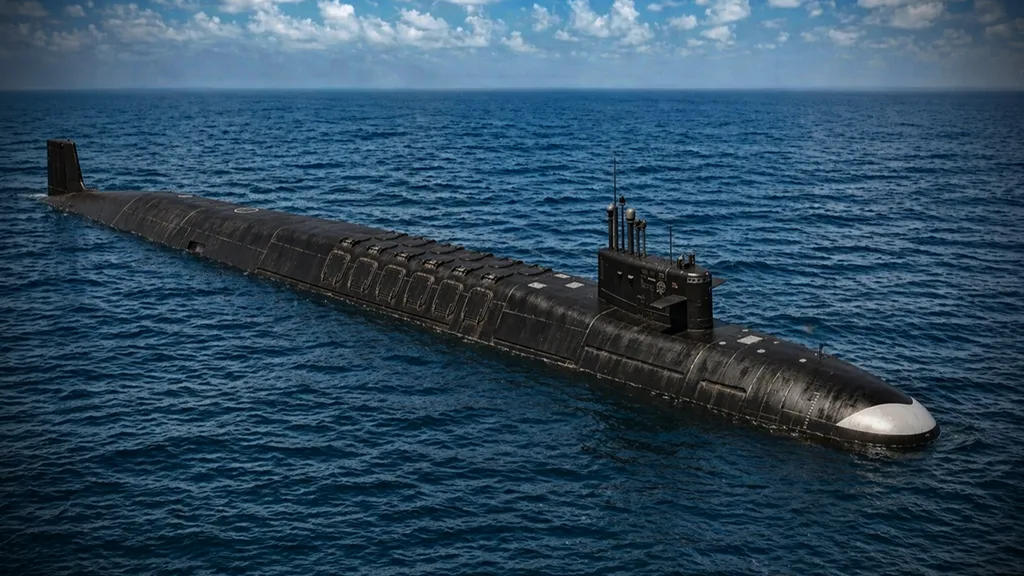
India's Nuclear Attack Submarine: A Game-Changer in Underwater Warfare
The Indian Navy is on the cusp of a major revolution in underwater warfare, with the development of its future Nuclear Attack Submarine (SSN), Project 77. This behemoth of the sea will be capable of delivering precision strikes against both maritime and land-based targets, expanding the country's strategic reach and cementing its position as a major player in the region.
At an estimated 10,000 tonnes, Project 77 will be one of the largest attack submarines ever operated by the Indian Navy. Unlike earlier concepts centred primarily on anti-submarine and anti-surface warfare, the new design places considerable emphasis on vertical missile launch capability, enabling the submarine to deliver large-scale precision strikes against both maritime and land-based targets.
The key to this transformation is a 24-cell modular Vertical Launch System (VLS) integrated into the submarine's hull. These large-diameter universal launch cells will allow the submarine to carry a diverse mix of long-range conventional strike weapons, including the BrahMos-ER cruise missile and the SLCM variant of the Nirbhay/Long Range Land Attack Cruise Missile (LR-LACM).
The BrahMos-ER cruise missile is a supersonic variant of the proven BrahMos family, designed to engage both heavily defended surface warships and strategic land targets at distances of up to 800 kilometres. Its high speed significantly reduces enemy reaction time while making interception considerably more challenging than subsonic cruise missiles.
For long-range land-attack missions, the submarine is also expected to field the Submarine-Launched Cruise Missile (SLCM) variant of India's indigenous Nirbhay/Long Range Land Attack Cruise Missile (LR-LACM). Flying at subsonic speeds while hugging terrain or sea surfaces, the missile is expected to provide stand-off strike capability exceeding 1,000 kilometres, with some variants potentially extending beyond 1,500 kilometres.
Project 77 has been designed with significant future growth potential. The submarine's universal vertical launch architecture and electronic fire-control systems are expected to be compatible with the under-development BrahMos-II hypersonic cruise missile, allowing future upgrades without requiring major structural modifications.
Beyond its missile inventory, Project 77 is also expected to introduce entirely new operational capabilities through the deployment of autonomous underwater systems. The submarine's large displacement will provide sufficient internal volume to embark and deploy Extra Large Unmanned Underwater Vehicles (XLUUVs), such as the proposed Jalkapi XLUUV, an autonomous underwater vehicle weighing approximately 20 tonnes.
These unmanned platforms could undertake a wide range of missions independently of the mother submarine, conducting reconnaissance, mapping underwater minefields, tracking hostile submarines and surface vessels, performing intelligence collection, or potentially functioning as remote weapon platforms.
The integration of XLUUVs reflects the Indian Navy's increasing emphasis on networked underwater warfare, where manned and unmanned systems operate together to improve situational awareness and enhance survivability in contested maritime environments.
As a Nuclear Attack Submarine (SSN), Project 77's mission will focus on sea control, escort operations, intelligence gathering, anti-submarine warfare, anti-surface warfare, and long-range conventional precision strikes. It will not carry India's K-series submarine-launched ballistic missiles, including the K-4 or future K-5, which are reserved exclusively for the Arihant-class and future S5-class Nuclear Ballistic Missile Submarines (SSBNs) that form the sea-based leg of India's nuclear triad.
This distinction allows Project 77 to optimise its internal layout for conventional strike missions rather than strategic nuclear deterrence, maximising the number of cruise missiles, torpedoes, and unmanned systems it can carry.
In conclusion, India's Project 77 is set to revolutionize the country's underwater warfare capabilities, providing a significant boost to its naval power and strategic reach. As the Indian Navy's largest attack submarine ever, Project 77 will be the game-changer in the region, cementing India's position as a major player in the Indian Ocean.